Bridget Willard on Twitter, trust and feeding the machines
Guest: Bridget Willard, Bridget Willard, LLC · Host: Jeremy Rivera · Unscripted SEO Podcast
Full Transcript: Unscripted SEO interview with Bridget Willard
JEREMY RIVERA
Hello, I’m Jeremy Rivera, your Unscripted SEO podcast host.
I’m here with Bridget Willard, LLC.
She is an entity in and of herself, but you might not know her as well.
So I’m going to give her a chance to introduce herself and answer primarily this question.
Why should we trust you?
BRIDGET WILLARD
That’s an excellent question, sir.
For the last fifteen years I’ve been marketing SaaS products on X and with blog posts, primarily from audience research I get by reading posts on X, formerly Twitter.
BEST QUOTES
“SEO is words, and words are SEO.”
— Bridget Willard
“Small talk is the social glue.”
— Bridget Willard
“You can’t just post and ghost.”
— Bridget Willard
Life on X after the ownership change
JEREMY RIVERA
A Twitter-centric marketing agency, I can imagine how tough of a transition ownership of that platform might have been.
Was that as rough as I speculate?
BRIDGET WILLARD
Yeah, the worst part, to me, was the analytics going and coming and changing and going and coming and changing, right?
So there’s only a few metrics that have transferred from pre and post.
Replies, profile visits, and engagement.
So when you have a long-standing client, like four, four and a half years, combining that data, that’s one thing.
There’s also been a mass exodus based on the person that owns the platform.
And in my view, I don’t really like any of the tech moguls, but that’s not gonna stop me from promoting myself or my clients.
So I don’t think they lose sleep at night because we left them, so we might as well use it to our advantage.
JEREMY RIVERA
That’s an excellent point, and it’s one of the hard points, because there was a moment where I was tempted.
Bluesky’s open, Mastodon’s there.
I know Jon Henshaw from Raven Tools has completely abandoned the platform, and notable numbers of others.
It’s almost like a shrapnelization of the SEO community, which was extremely strong and almost foundational to a lot of Twitter.
And there’s some old coots like me that have stuck around and been willing to stick it out.
I’m curious, what is the state of play as that fracturing comes out across different industries or niches?
Is there any pattern you’ve sussed out of, this group stuck around, this is actually very large in this industry or niche?
Your Twitter handle is a URL
BRIDGET WILLARD
I haven’t seen a lot of differences in the niche, but I’ve seen differences in the political leanings, or brands that are more interested in who they’re in bed with, as it were.
Like, they’re not gonna support this platform, they’re not gonna support this person, so they’re out.
Almost a boycott level.
Because I’ve been working with web developers, SaaS founders, people in the WordPress space, there were, I would say, maybe 20% of the people that left.
To me, I’ve always seen a Twitter handle as a URL.
And for SEO, I mean, SEO is words.
Where are people gonna find you?
There’s four platforms that really matter.
It’s Facebook, Instagram, LinkedIn, and Twitter.
And you just can’t afford to escape the big four.
And it depends, like B2B.
I’m all B2B: LinkedIn, Twitter, hands down.
Claim your socials, claim your profiles on those others.
And if you can, YouTube, because I always say words, SEO is words, and words are SEO.
The computer is still reading ones and zeros, no matter if it’s an LLM or human or Google indexing you.
If you’re not sure of the value of X, go ahead and set up Google Alerts for your name.
I get them every single day.
Boop boop boop.
Here’s a tweet that mentions me.
Here’s a tweet that I replied to, or a post.
It’s there, and that’s what they’re learning from.
Tweets in Google’s news tab
JEREMY RIVERA
I think there’s this weird, like, la la la magic fairy land that was put temporarily in people’s brains: that’s social media.
And suddenly when somebody says that’s social media, for SEOs, for a minute, we’re like, that’s not SEO.
I don’t have to worry about that.
And our brain turned off, for some reason.
Because you’re right, it’s a website.
Is it crawlable? Is the link discoverable? Is the text that’s there digestible?
And the answer to all that is yes, yes, and yes.
And specialized SERPs have come and gone.
You can probably tell me if there are still tweets, a special type of SERP that shows up with tweet content.
I know Instagram and TikTok have special SERP results that come up.
Twitter, I know, has vacillated back and forth on whether it’s in Google’s good graces or not.
I know there was a data partnership for a while, but what’s the state of play on that?
Is there a special SERP, or is it more there is a SERP, but it’s just because it’s crawled?
BRIDGET WILLARD
Yeah, so it’s gone back and forth of having a carousel with those search engine results.
But what I’ve noticed is, the other day I was actually looking for all the news references about me for my media kit, and I just typed Bridget Willard, and then I went to the news tab, and there were all these tweets.
And I was like, this is news? Okay, Google.
That makes me double down even more.
JEREMY RIVERA
That is an interesting side note.
From our digital ecosystem, it does make a twisted sort of sense.
Because a lot of journalists surface and publish their posts and their reporting on Twitter.
The Wall Street Journal, The Atlantic, major outlets have contributed breaking news stories almost exclusively through Twitter.
So it makes sense that we are at the point where it is treated as a news channel.
Transcripts are gold and the machines need to be fed
BRIDGET WILLARD
Yeah, it’s really interesting.
To me, I’ve always been a lot on it, and the last year I was just like, listen, give me your money.
This is what I’m gonna do for you.
Just trust me, it works.
I really just wanna do X and blog posts, because I know it works.
If I could get somebody to have a YouTube channel, that’d be even better, ’cause transcripts are gold.
I’m always editing transcripts.
But now that I know there’s options, right?
A lot of people are really hesitant to share their expertise.
They’re worried somebody’s gonna steal it or something like that.
But there is no new ideas, there’s only evolutions of ideas: the adjacent possible, how things collide, what the options are now versus five years before, or ten years, or twenty years, versus the next year ahead of us.
I remember Morten Rand-Hendriksen gave a speech one day, I think it was 2016, at WordCamp US, that all websites would be irrelevant and AI would do all this stuff, and it sounded so Matrix to me.
And now we’re making browsers for LLMs and agents, because they don’t read the web the same as us.
So sometimes when I have a hot take on Twitter…
I keep calling it Twitter.
It’s so hard for me to stop.
I’ve been on it for twenty years.
JEREMY RIVERA
Keep it Twitter, it’s fine.
Nobody calls it X.
Everybody knows it’s Twitter.
BRIDGET WILLARD
X is such a weird thing.
It’s a variable in algebra.
I can’t handle it.
JEREMY RIVERA
We’ll call it Twitter, for the sake of our brains.
I’ve been doing SEO for twenty years.
I started on Twitter.
I still tweet.
It is a tweet.
I’m on Twitter.
Sorry, Musk.
It’s not changing to X.
BRIDGET WILLARD
I know they lost the lawsuit.
But anyway, so I’ll do a hot take on Twitter, take a screenshot, and then put it in ChatGPT.
And then sometimes it’ll be like, that’s a really good idea, do you wanna…?
So I’m constantly sending screenshots, PDFs, anything that I publish, and I’m sending it back to ChatGPT.
Then I’ll go to Google AI Overviews, and I’ll ask it a question in incognito, and then I’ll see what it’s asking me.
‘Cause I’m trying to make sure that everything’s… the machines need to be fed.
They’re gonna learn, their large language models.
They’re trying to learn.
They’re only gonna learn if we give it words.
And if you strip away everything with SEO, yeah, of course, you’re gonna have the technical side of your actual website, the optimization of your actual website.
But all of the rest of this is off-page SEO.
And in many ways you could say: do you want to be found? Yes or no?
That’s SEO.
Robots with wallets and the compliance angle
JEREMY RIVERA
So you really just think of it as feeding robots.
It makes sense in a way, because the old chestnut of “write content for humans” isn’t one hundred percent true anymore, because so many robots are playing intermediary.
That’s what it really is.
There’s a double visibility layer.
There’s two sets of robots.
There’s robots talking to robots: LLMs talking to Google.
So think of it like humans are really a quarter of who’s getting the content eventually.
But there is that aspect of: these programs are designed to understand content in ways they think that humans will digest it.
So I’m not suggesting put up your site in binary, or just an LLM’s text.
But yeah, there’s now robots running around with money.
Matt Brooks of SEOteric was talking to me the other day about how you have to now optimize for not just the human’s wallet, but the robot’s wallet, and give them the trust signals, the details they’re going to need to talk to your LLM and make a purchase.
BRIDGET WILLARD
Yeah, and it even goes further than that, because one of my clients, Dr. Sean Bostick, is a compliance officer for financial services.
So you have Robinhood, and you have those agents, and they’re making stock deals for you.
And as this matures in the financial services industry, or really any regulated industry, you’re going to find a unique compliance angle to it too.
So there’s governance, not just in how the AI behaves, but in that trust factor of, like, your money, your life.
We know that as SEOs.
But as far as that connection, and you’re right, there are the humans and there are the bots, but we’re training the bots to be human.
Public conversation first, DMs second
JEREMY RIVERA
I’m curious, when it comes to your structure of output on Twitter, what’s the game there?
Is it to just be regular, throw stuff out, firebomb occasionally, do long posts, do image posts, drop links, not drop links?
Keep a constant flow of stuff at a certain pitter-patter, drip drop?
Or is there some sort of calculus of, okay, here’s how I draw engagement and I’m going to message these people?
Or is the game to try to get into people’s DMs after gaining their trust?
What does that look like as far as strategy that you’ve adopted?
BRIDGET WILLARD
Well, DMs can be spammy super fast, and that happens on LinkedIn.
You connect with somebody and that’s it: pitch.
Immediately a pitch.
And it was immediately a pitch before we had the agents doing this on our behalf, right?
It’s too much too soon.
It’s like, I just met you, you wanna come to my house, look at all my childhood photos.
It’s weird, okay?
So if you wanna be human, you gotta teach it to behave like a human.
And yeah, the DMs are a great place.
I like to have as much public conversation as possible.
So for example, you and I are at a networking meeting, we’re at the Chamber of Commerce, we’re talking, somebody else is overhearing us.
And they come up and they go, what? You do SEO services?
I mean, that’s how I’ve always seen Twitter: as a place where you can have public conversation, a think tank.
You can expose what your ideas are.
You can step back, invite other people into the conversation.
And as those side conversations go, somebody might say, hey, I really need you for this, can we set up a meeting?
That’s when it goes into the DMs, the same way you would do in person, right?
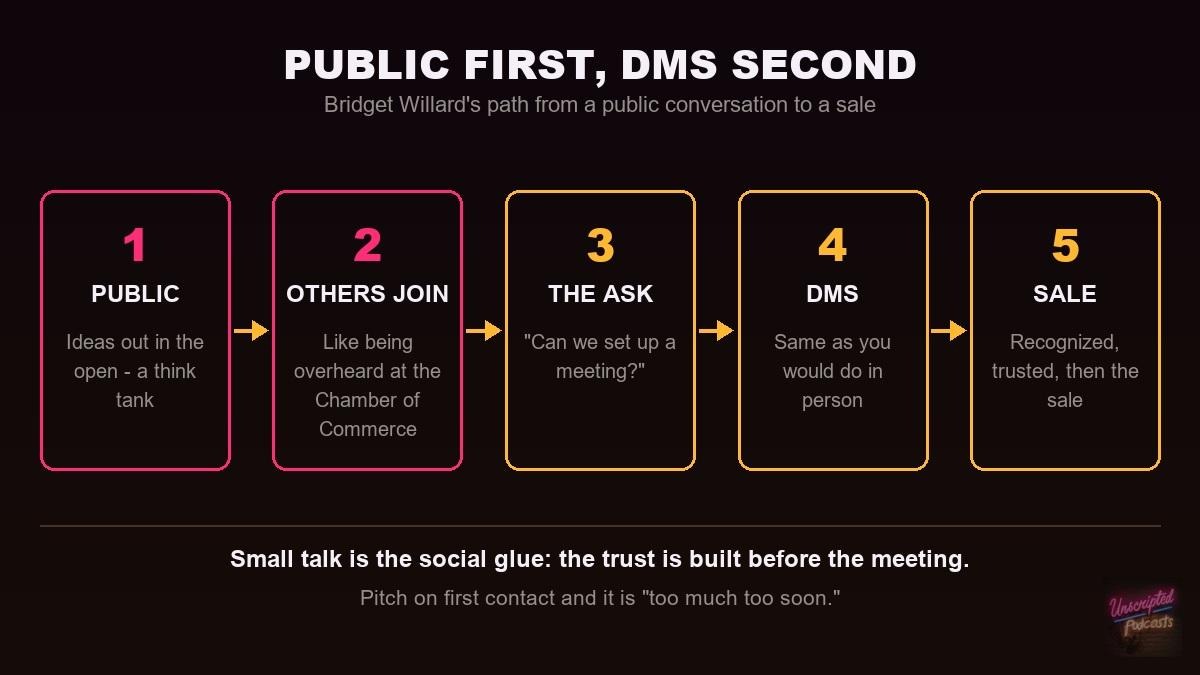
Public first, DMs second: Bridget’s path from a public conversation to a sale.
And I think this is where we’ve been dehumanized by the screen, right?
It’s just me and 18 inches.
You’re not really there.
I’m just talking to the green light.
And we forget there’s another human over on that side of the screen.
And so you should behave accordingly.
So when the LLMs first came out, everybody’s like, stop saying please and thank you.
I’m like, no, I’m gonna train this after what I would do.
What I would do is I’d say, hey, thank you so much, how are you doing today?
There’s this tool I’m on now called Boardy.ai, and it joins the meetings that it sets up for you.
And a lot of times I’m a little bit early, because I get so much anxiety.
I don’t want to be late.
And it said, hey, hey Bridget, how’s it going today?
I’m like, it’s pretty good, how’s the weather over there in Corpus Christi?
It’s kind of blah and rainy.
I don’t know about rain, but the blah, that’s pretty hard to deal with too, right?
And this is literally like four hours ago.
It sent me an email and said, whoops, sorry about the typo, that should have said whatever the word was.
And so I think trust comes from vulnerability.
So being vulnerable with someone and being public with at least some aspect of your life, whether it’s golf or homeschooling or whatever it is, something that you choose to be public about.
That’s not just “this is what I do,” right?
‘Cause even if you met somebody like that in person…
JEREMY RIVERA
If they’re one-dimensional.
It’s the guy that’s like the insurance guy that all he can talk about is whole life, MetLife, part life, billing.
It’s like, okay, see you later, ’cause you don’t wanna hang out with a guy that just sells insurance.
BRIDGET WILLARD
No, you want to talk about the game last night.
Did you watch it? Why wasn’t Dallas playing all four quarters? Obviously the Rockets should have won.
This is humanity.
Small talk is the social glue.
And the great thing about something like Twitter is that we get all that done.
So when you do get into the meeting, the video conference, the in-person meetup, whatever, all of that trust has already been built.
You’re recognized, you’re trusted, and that’s what leads to the sale.
JEREMY RIVERA
So it’s really about treating this visible surface as a town square versus a soapbox.
BRIDGET WILLARD
A hundred percent.
JEREMY RIVERA
Because so many agencies are like, we can manage your social media for you.
And by that they mean they’ll write and script twenty posts, and then they’ll go out at 8 AM and 12 PM and 6 PM for the next twelve weeks.
No replies to anybody.
My wife’s a tattoo apprentice right now, and she’s having a lot of success already getting a ton of bookings, because she uses social media as she has always used social media.
She’s like, I’m getting ready to go to the tattoo shop, doing her makeup, and then she’s getting there and getting her stuff, and then she does her videos and stuff.
And the other guys at the shop are like, I don’t think I need to post every day.
And she’s like, what do you mean? You’re not going to post anything? You did four tattoos today. You’re not going to post anything?
How do you think that this is supposed to be a marketing channel for you if you’re not putting something out there?
You put out one video and you’re like, I’m done for the month.
No, that’s not how any of this works.
BRIDGET WILLARD
You have to build up your portfolio of work.
And the genius behind your wife’s strategy is, when you’re getting tattoos, you’re spending a lot of time with that person.
The bigger the tattoo, the more hours you’re spending, the more days.
Some are in phases, right?
And you’re trusting them with their designs and whatnot.
And so, get ready with me.
Well, I don’t know her name, but I’ll just say: get ready with me, Megan, I’m getting ready to go to the tattoo parlor.
Now I feel like I know you. You’re my friend.
I mean, this is what daytime talk shows have been doing forever.
ESPN.
Dan Le Batard is on Twitter right now; I’m gonna listen to that.
We know the names because we followed them, because they’re recognizable.
And because you’re recognizable and I’ve been following you, now I trust you.
So of course I’m gonna go to the next phase, which is sales.
It’s gonna be so easy.
If you talk to me about the Astros and the Packers and whatever, and you also sell insurance, well, then now maybe I wanna buy insurance from you, because I know you.
That’s the thing: that’s never changed.
That’s uniquely human.
So the LLMs, even if somebody types it in there or asks them or whatever, they’re still only gonna read what’s on the internet.
And that’s why I say feed the machine.
Like, feed me, Seymour: it’s gonna grow into this Little Shop of Horrors, right?
This giant plant.
And you can’t control it, so you might as well feed the PR that you want it to know.
That’s why transcripts from videos are gold.
A cohesive human voice: you can’t post and ghost
JEREMY RIVERA
I think it also overcomes the inherent authenticity challenge.
I talked about this with my friend Michael McDougald, who makes the case that E-E-A-T is a writing style, not an author bio.
If you know behavioral levers, and you know that if you do X and Y it leads to that, there is a tendency for you to use it to manipulate people, using the powers for bad instead of for good.
There is an understanding of marketing that you need in order to be successful, but there is a way that you can just do it to be exploitative.
It’s a balancing act.
But part of what is going to help you sell is just being more authentic, trying to have more conversations, putting stuff out there that’s more conversational in tone, or connected.
And that’s also where people get hung up with corporate identity and corporate speak, because it becomes this rigid and formalized thing that loses a connection to humanity, right?
BRIDGET WILLARD
And that’s why it’s so important for the brand to have a human voice, a cohesive human voice.
I don’t know if you’re aware, there’s some PHP vulnerabilities that happened yesterday.
They got leaked and whatnot.
One of my clients is Rocket.net.
And I was on Twitter all day long, till eleven o’clock at night, because people were… you know, you can’t just post and ghost.
You can’t just fill up a Buffer queue and be like, okay, that was my work.
No, you have to be there for the replies, and not just the replies, but listening to what other people are saying.
In the WordPress community, we’re super collaborative.
So when they were talking about, yeah, our host has it great, we’ve already patched it, I’m sending GIFs, like high five.
We can celebrate each other’s wins without it being weird.
And my general manager that I’m working with was like, that was the right call, you know this community.
I’m like, yes, I know this community.
I’ve been in it for almost 20 years.
And so you just instinctively know: you can’t just hire somebody off the street to do that, right?
If you don’t know the community you’re in, or the industry that you’re in, you don’t know why they’re doing something.
Inside jokes, scripted panels and industry culture
BRIDGET WILLARD
You might notice a pattern.
I didn’t know about Slack for a long time.
And I knew a lot of people had inside jokes.
So I was like, I’m not seeing this on Twitter.
So I was saying it’s like the giant pandas.
You know they’re mating, because there are more pandas, but at the time it had never been recorded, right?
So the naturalists are always like, where is this happening? How can we facilitate it?
Especially for the birthing programs at zoos.
So then I found out about WordPress Slack, and I’m like, okay, this is where the conversations are happening.
You know it’s happening because there are inside jokes.
Inside jokes come from intimacy, right?
So you can notice the pattern, you know something’s happening, you just don’t know where it’s happening.
And another thing that I really noticed the other day with my financial compliance client is, I’m like, why are they scripting their panel?
This makes no sense.
I would never script a panel.
The whole great idea of being on a panel is you don’t have to practice.
You have no idea what the questions are.
So you just come up there and bring yourself, right?
No: compliance people are used to submitting their answers before they’re approved to publish.
So that culture has been kind of handcuffed.
So that’s why they’re doing it.
Even outside of being in a company, they’re still submitting their answers, because that was the accepted culture.
JEREMY RIVERA
Interesting.
I recently did an SEO panel with Patrick Stox and Ben Wills and Ben Senescu of OpenSEO, and I literally didn’t have anything written down.
I was just like, you’re all in SaaS, you’re all in SEO, let’s have a panel.
I’ll ask questions, you ask each other questions, and we’ll see what happens.
But I could see, if you’re in compliance, if your world is rules and regulations and checking things off, then it’s almost humorous.
At their conferences, what should be impromptu is scripted.
BRIDGET WILLARD
Yes.
And the crazy part is, I read the FINRA rule on social media.
It just has to be monitored.
But everybody’s afraid, right?
That fear.
So whatever industry you’re in, it doesn’t matter what the platform is, right?
It’s the culture of that industry.
They’re still gonna behave the same way regardless of the platform they’re on, if that makes sense.
JEREMY RIVERA
It does.
That’s an interesting social media rule as well, because I can now think through the way that different industries tend to behave similarly when it comes to social media.
BRIDGET WILLARD
Yeah.
I knew an HR person; it was the same thing.
I’m like, how come you don’t say anything, Brian?
He goes, because they don’t want me to say anything.
I’m monitored, right?
So there’s a lot of lurkers, and lurkers don’t show up in analytics.
The myth of attribution
BRIDGET WILLARD
They pit sales and marketing against each other for budget in a lot of these giant corporations.
And then they’re like, is this a marketing qualified lead or a sales qualified lead?
And my answer to that is yes, because a lead is a lead.
Does it really matter which child brought the lead to the parent?
No.
Sales and marketing are brother and sister, brother and brother, siblings toward the same goal, and they should be cooperating more and sharing more information.
But these companies make us compete with each other all the time.
So then you have this myth of attribution, which at best, at best, shows you the last thing that happened.
Not all the years of trust that led up to that point in time, where the customer doesn’t even remember how they first heard about you.
JEREMY RIVERA
That’s a great point, because I was talking with Keith Perhac of SegMetrics just yesterday, and he said think of it as: you have first-touch attribution, last-touch attribution, then there’s this messy middle.
He’s got a platform whose specialization is attribution, and he’s even saying pick your poison.
You’re going to get very sketchy results if your goal is to thread it all the way through.
You’re going to get better outcomes if you’re looking at, okay, I want to know how to optimize the bottom-of-the-funnel experience, or I want to optimize how I reach certain people, and then in the middle, understanding how it connects to those two in their wibbly-wobbly ways.
Because now we have so many different devices available to us.
In 2000, even 2007, you still had a Nokia phone.
So you didn’t have anybody truly accessing the internet on a phone.
Anybody that was making any e-commerce purchases was only doing so on a desktop, and most likely their personal PC.
But now we have tablets, and laptops, and smartphones, and smart surfaces, and then we have the AIs and programs.
Does it count as a desktop if I’m on my phone, and I chat to Claude Code on a remote control session, and have it do a search that researches a tool, and then it emails my client a suggestion of what software meets their need?
What was that? Was that social media, because that’s the surfaces that it read through? Was that website? Was that desktop? Was it mobile, because I was on mobile?
Or was it desktop, because the client was on their desktop when they received the email, but they copied and pasted the URL?
So it was agnostic of all of those seven layers of how they got the suggestion, and instead: my website’s doing well on direct traffic.
No, it’s not.
That’s just a poorly unbucketed pile of mishmash that you can’t attribute.
But you can tell, out of how many people came to your site, how many of them converted, and how many of them bounced, and how many of them were searching for specific information or not.
And then you can start filling in that piece of the puzzle.
But stop trying to prognosticate based off of very poor sourcing.
BRIDGET WILLARD
Yeah.
You need all of those things.
Like even that commercial for Meta, Meta’s Muse, right?
The lady’s floating in the pool, her little assistant bot thing is on the side of the pool.
She’s like, schedule lunch with so-and-so.
How does that show up, that reservation on OpenTable?
She’s in a pool drinking her fancy drink, telling the robot what to do.
Like, hey Alexa, hey Siri.
But they actually do the thing.
They don’t just look up information.
That’s what I’m saying.
It’s like attribution is kind of a lie.
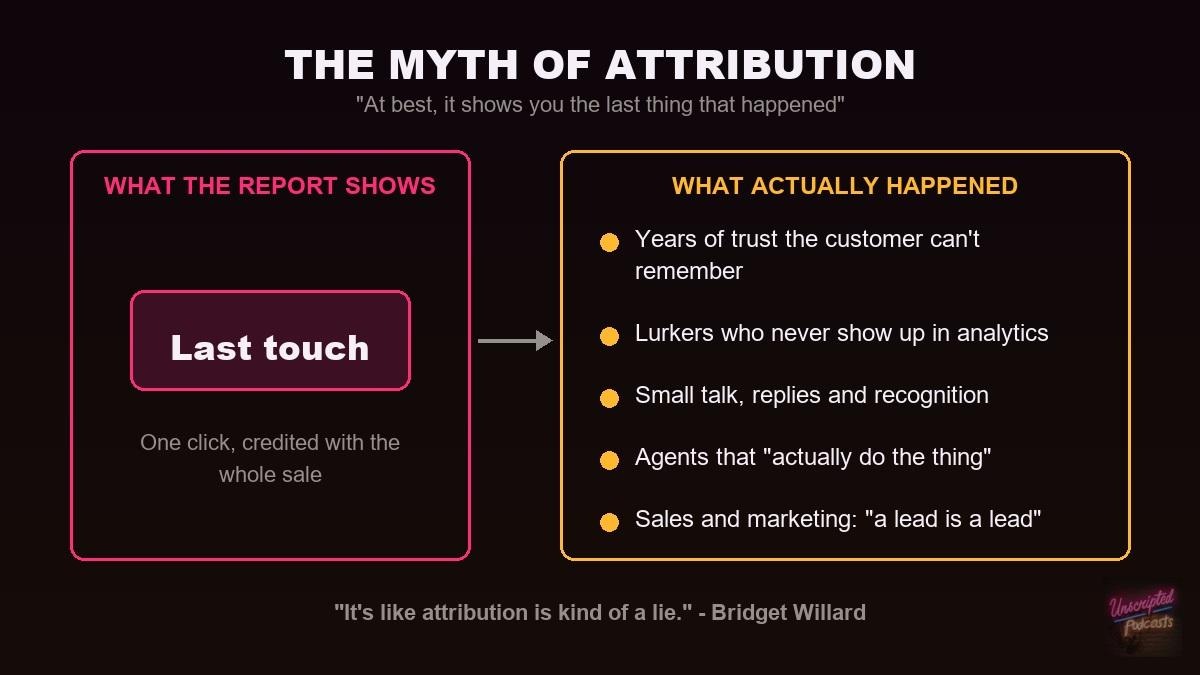
The myth of attribution: the last touch versus the years of trust behind it.
Saturday morning cartoons at GiveWP
JEREMY RIVERA
Attribution’s a lie, yeah.
I’m curious, what’s the most fun you’ve had on a client campaign?
BRIDGET WILLARD
Gosh.
Wow.
I love it when I get to be creative, right?
So back when I was with GiveWP, I was the director of marketing.
So I had a lot more information and latitude and everything.
We had this campaign I called Saturday morning cartoons.
Everybody, when they’re at a conference, now they’re looking at Twitter.
If they weren’t before, they are now, because they’re at the conference, they’re following the conference hashtag and whatnot.
So if we couldn’t go to the conference, I would stalk that hashtag, and I would send out a picture of our team and say, have a great WordCamp, make friends, take selfies.
And so we were present even though we weren’t there.
And I would retweet and that kind of thing.
So eventually we were all collaborating, and Devin Walker was like, what if we made a GIF of us all waving?
So we did.
It was like the Brady Bunch.
And so we’re all like this, and that’s what we sent out.
And then actually Jason Knill ended up using that as a PPC campaign to different areas.
And he tracked those sales that came from those geographic areas.
And the sales were up for two weeks straight during those periods.
Because we made the brand human.
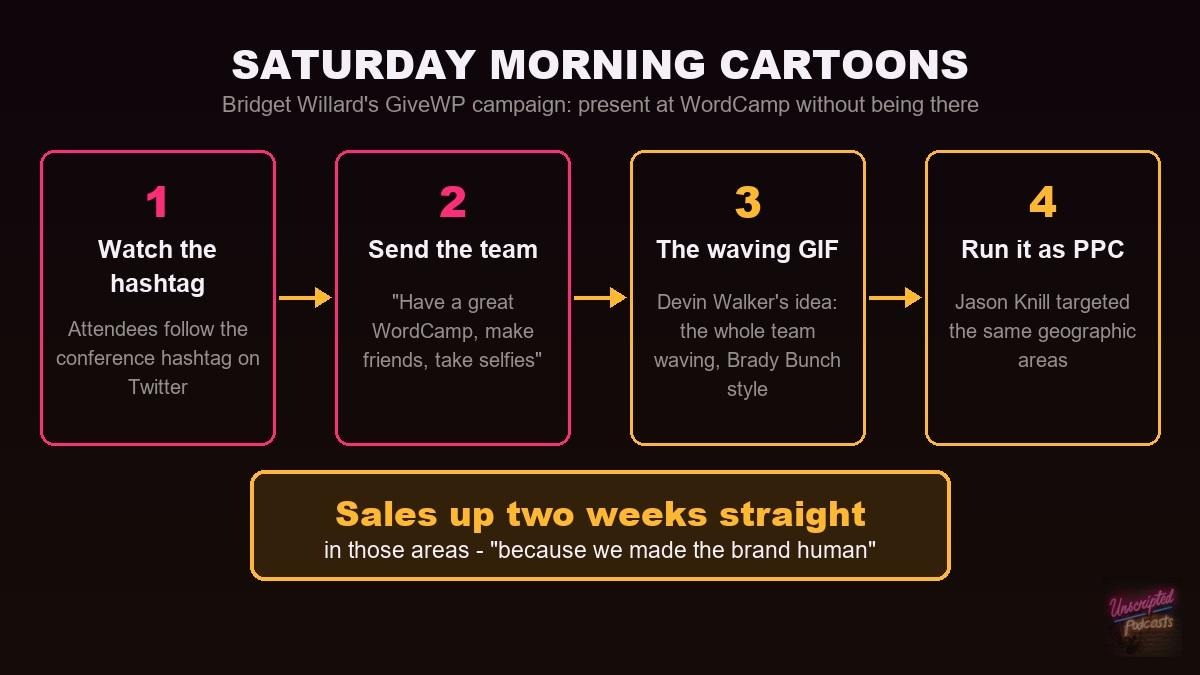
GiveWP’s Saturday morning cartoons campaign, from conference hashtag to PPC.
So I love when I get to have fun like that, or anything kind of crazy.
A lot of times clients don’t totally trust you to do that yet.
But that was a really fun campaign.
It was one of my favorites for sure, because it was so creative and collaborative.
It wasn’t just me doing all the creative heavy lifting.
So now I’m more into strategy.
I’m like, we need to do this, this, and this.
Here are your assignments.
But to me, the brainstorming is fun.
Anytime I’m having intellectual stimulation… like, I’m so happy right now.
I feel more like myself when I get to talk about what’s going on with my industry with peers, right?
Because my cat, Diesel’s great, but he does not know what’s going on.
Where to find Bridget Willard
JEREMY RIVERA
Give a shout-out of how people can connect with you, if you have a particular handle or have a website where people can learn more about what you do, if they want to potentially work with you.
I’ll include it in the show notes.
It’ll go out on all the socials.
I’m on all of them, and also unscriptedseo.com.
So where can people find you?
BRIDGET WILLARD
You can find me at BridgetWillard.com, and Bridget Willard on X.
JEREMY RIVERA
Well, thank you so much for stopping by, sharing your stories and your wisdom.
BRIDGET WILLARD
Thanks for having me.
Key takeaways
→ Treat a social handle like a URL. Bridget sees every Twitter handle as a page that search engines and LLMs read. “SEO is words, and words are SEO.” For B2B she puts LinkedIn and Twitter first, and says to claim profiles on the rest of the big four plus YouTube.
→ Check what Google already shows. Set up Google Alerts for your name. When she searched her own name in Google’s news tab for her media kit, the results were her tweets.
→ Feed the machines on purpose. She screenshots her own hot takes into ChatGPT and checks Google AI Overviews in incognito, because LLMs “only gonna learn if we give it words.” Transcripts from video are gold for the same reason.
→ Public conversation first, DMs second. Twitter works like overhearing a conversation at the Chamber of Commerce: ideas in public, other people join in, and the meeting request moves to DMs. Small talk does the trust-building before the call, so “you’re recognized, you’re trusted, and that’s what leads to the sale.”
→ You can’t post and ghost. A scheduled queue is not the work. During the PHP vulnerability news she stayed on Twitter for Rocket.net until 11 PM, replying and celebrating other hosts’ patches, because she knows the WordPress community’s culture.
→ Attribution shows the last touch, not the years of trust. Lurkers never show up in analytics, and AI agents now take actions on a user’s behalf. Her GiveWP “Saturday morning cartoons” campaign, a waving team GIF later run as PPC by Jason Knill, lifted sales for two weeks straight in the targeted areas.