
What 191,138 Posts Reveal About Relationship-Driven B2B Marketing on X
A 15-Year Longitudinal Case Study of Conversation, Professional Networks, and SaaS Business Development
Bridget Willard
SaaS Marketing Consultant | Bridget Willard, LLC
November 2026
Executive Summary
Social media marketing is often evaluated by how much a business publishes and how many people its content reaches. Content calendars, impressions, engagement rates, clicks, and follower growth dominate reporting.
Those metrics describe activity and visibility. They do not necessarily explain how professional relationships develop, why someone becomes recognizable within a market, or how those relationships contribute to business development.
This white paper examines a different approach.
An analysis of 191,138 archived posts from the X account @BridgetMWillard, spanning May 18, 2011, through November 20, 2026, reveals a sustained emphasis on conversation rather than broadcasting.
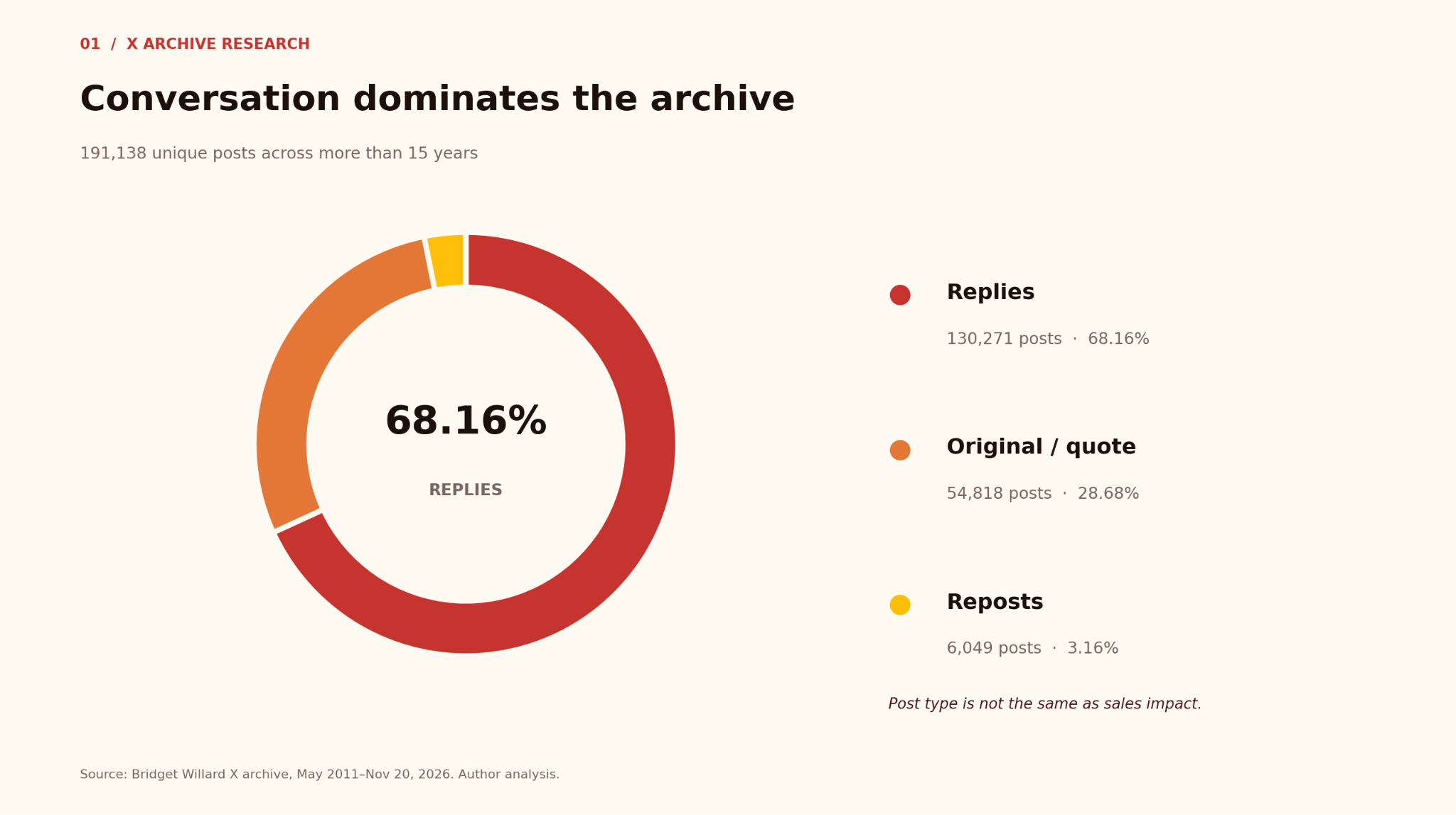
Of those posts, 130,271 were replies, representing 68.16% of the account’s recorded activity.
The archive also demonstrates that conversational activity extends beyond isolated exchanges. At least 1,335 distinct reply-target accounts appeared in three or more calendar years, and 502 appeared in five or more years. Some relationships remained visible for more than a decade.
This historical activity predates the account owner’s current SaaS-focused positioning. It documents participation in social media, marketing, WordPress, software, and agency communities over successive professional periods.
The evidence supports four principal findings:
- Conversation has been the dominant observable form of account activity across the historical record.
- Repeated interaction with identifiable accounts is a substantial feature of that activity.
- Professional topics and promotional positioning evolved, while conversation remained a recurring behavior.
- Relationship-driven marketing requires attention not only to how businesses engage, but also to whom they engage with and why those audiences matter.
The research does not establish that reply volume caused sales, that repeated interaction automatically created trust, or that every recurring account belonged to an ideal customer profile.
Instead, it offers a documented example of sustained professional participation and a practical framework for SaaS companies seeking to connect social media with business development.
The central argument: Social media marketing should not be measured exclusively by what a company publishes. It should also be evaluated by the relationships it develops within its relevant market.
1. The Problem With Broadcast-First Social Media Marketing
Many B2B marketing programs begin with a content calendar.
The calendar determines what the company will publish, when it will publish, and how often each message will appear. Content is then distributed across social platforms, and performance is evaluated through a reporting dashboard.
This approach solves an operational problem: maintaining consistency.
It does not necessarily solve the business problem of becoming known and trusted by the people who might buy, recommend, or influence the purchase of a company’s products.
A software company can post every day without developing meaningful relationships with customers, founders, industry professionals, or referral partners.
It can accumulate impressions from people who have no involvement in its purchasing ecosystem.
It can even earn substantial engagement while remaining unfamiliar to the decision-makers it needs to reach.
For SaaS companies, this distinction matters.
Software purchases often require buyers to assess risk, understand functionality, evaluate alternatives, and develop confidence in the company providing the product. Visibility may introduce a vendor, but visibility alone cannot resolve those concerns.
A content calendar helps maintain a public presence. It does not, by itself, establish relationships.
This suggests that B2B social media strategy needs to ask questions beyond publishing frequency.
- Who is becoming familiar with the company?
- Which professional communities recognize its expertise?
- Who participates in its conversations?
- Are customers, prospective buyers, referral partners, and industry peers represented?
- Do those interactions continue beyond a single post?
- And how does the company translate market participation into better customer understanding and appropriate commercial opportunities?
These questions shift attention from content output to relationships and business relevance.
The difference between attention and recognition
Attention occurs when someone notices a post. Recognition develops when a person or company becomes familiar through repeated encounters.
A prospective customer might see a SaaS company’s post without remembering its name. Repeated exposure to useful contributions in relevant conversations creates additional opportunities for that name, expertise, and professional identity to become familiar.
Recognition is not identical to trust. Someone can recognize a company without believing its claims or wanting to purchase its products.
But recognition creates an opportunity for trust to develop through subsequent experiences.
This is the starting point of relationship-driven marketing.
2. Research Design: A 15-Year X Archive
Supporting Research and Data Transparency
This white paper draws on a historical archive of 191,138 posts published by @BridgetMWillard between May 18, 2011, and November 20, 2026.
The archive was processed into structured datasets and evaluated through a supplementary longitudinal analysis conducted using Grok.
To support transparency and independent examination, the findings, methodology, dataset audit, selected relationship examples, and research limitations are publicly available:
Read the Grok Research Findings and Methodology (PDF)
The supporting report is an analysis of the underlying X archive, rather than a publication of the complete raw dataset. Its conclusions are observational and do not establish direct revenue attribution.
The dataset
This study uses an archive of posts published by @BridgetMWillard between May 18, 2011, and November 20, 2026.
The original X archive was supplied in four JavaScript files. These were processed into structured records, combined, and checked for duplicate post identifiers.
The resulting dataset contains 191,138 unique records.
The analysis classified records into three categories using the available metadata and post text:
| Post category | Count | Share |
| Replies | 130,271 | 68.16% |
| Original and quote posts | 54,818 | 28.68% |
| Reposts | 6,049 | 3.16% |
| Total | 191,138 | 100% |
The original-and-quote category includes posts that the export method could not always distinguish from one another. Reposts were identified through text patterns beginning with an RT attribution.
The archive contains post dates, post text, identifiers, available reply-target metadata, mentions, links, and some interaction counts.
Where available, post identifiers permit direct reference to the original public posts.
Research questions
The study examines five questions:
- To what extent has conversational participation characterized this account’s activity over time?
- How frequently does that participation involve recurring accounts rather than one-time exchanges?
- How did the account’s professional focus evolve across different business periods?
- What evidence exists of audience selection, contextual expertise, promotion, and professional network development?
- Which observed practices could SaaS founders and marketing teams reasonably adapt?
Methods
The quantitative analysis uses the complete available dataset for aggregate counts, activity by year, reply-target frequency, and multi-year account persistence.
A reply was defined by the classification produced from archive reply metadata.
Recurring accounts were identified by grouping reply targets and comparing their dates and calendar years.
For the relationship analysis, reply handles were normalized for case where possible. Historical handles may have changed, and some metadata may be incomplete.
A supplementary thematic analysis examined the presence of specific terms in post text and reviewed selected historical examples. Keyword counts were treated as indicators of explicit language, not definitive measurements of an account’s professional interests or strategy.
Earlier qualitative analyses produced using Grok were also reviewed. Their interpretations were considered preliminary and were not treated as independently verified business outcomes.
Limitations
This is an observational, single-account case study.
The archive represents the account’s own recorded activity. It does not provide comprehensive copies of every other participant’s messages or complete evidence of mutual conversation.
It does not contain verified impressions for every post, the full history of account-profile changes, private business conversations, customer records, or closed-revenue attribution.
Repeated replies cannot establish the strength or reciprocity of a relationship without additional evidence.
The dataset can demonstrate sustained activity. It cannot independently prove that a particular interaction caused a purchase.
Those distinctions are important throughout the analysis.
3. Finding One: Conversation Was the Dominant Activity
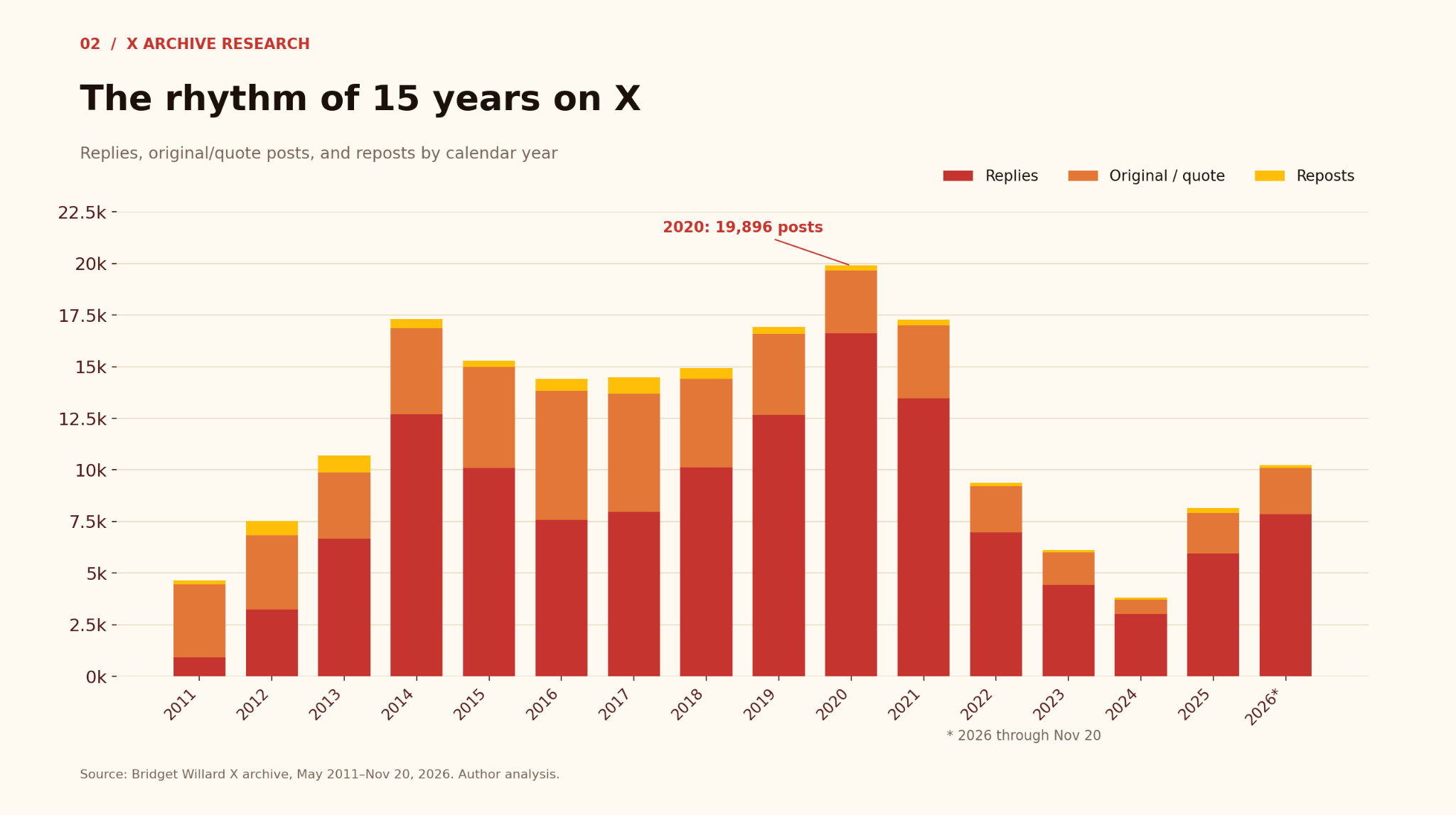
Of the 191,138 posts in the archive, 130,271 were classified as replies.
That is approximately 68 out of every 100 posts.
This result is especially meaningful because the dataset spans more than 15 years, multiple changes to the platform, and several phases of the account owner’s professional career.
A strategy based primarily on broadcasting would be expected to feature a larger proportion of standalone publishing activity.
This archive instead documents sustained participation in conversations initiated by other accounts, alongside original posts, quote posts, and reposts.
Annual activity
| Year | Total posts | Replies | Reply share |
| 2011 | 4,644 | 923 | 19.9% |
| 2012 | 7,523 | 3,229 | 42.9% |
| 2013 | 10,705 | 6,675 | 62.4% |
| 2014 | 17,300 | 12,681 | 73.3% |
| 2015 | 15,289 | 10,109 | 66.1% |
| 2016 | 14,416 | 7,579 | 52.6% |
| 2017 | 14,485 | 7,980 | 55.1% |
| 2018 | 14,940 | 10,119 | 67.7% |
| 2019 | 16,923 | 12,675 | 74.9% |
| 2020 | 19,896 | 16,628 | 83.6% |
| 2021 | 17,292 | 13,468 | 77.9% |
| 2022 | 9,378 | 6,965 | 74.3% |
| 2023 | 6,124 | 4,418 | 72.1% |
| 2024 | 3,815 | 3,017 | 79.1% |
| 2025 | 8,165 | 5,942 | 72.8% |
| 2026* | 10,243 | 7,863 | 76.8% |
2026 data ends November 20.
The account’s behavior changed considerably during its earliest years.
In 2011, fewer than one-fifth of archived posts were replies. By 2014, replies represented nearly three-quarters of activity.
*Of note, there was a huge attendance of TwitterChats during 2013-2020. Many of those posts are considered replies.
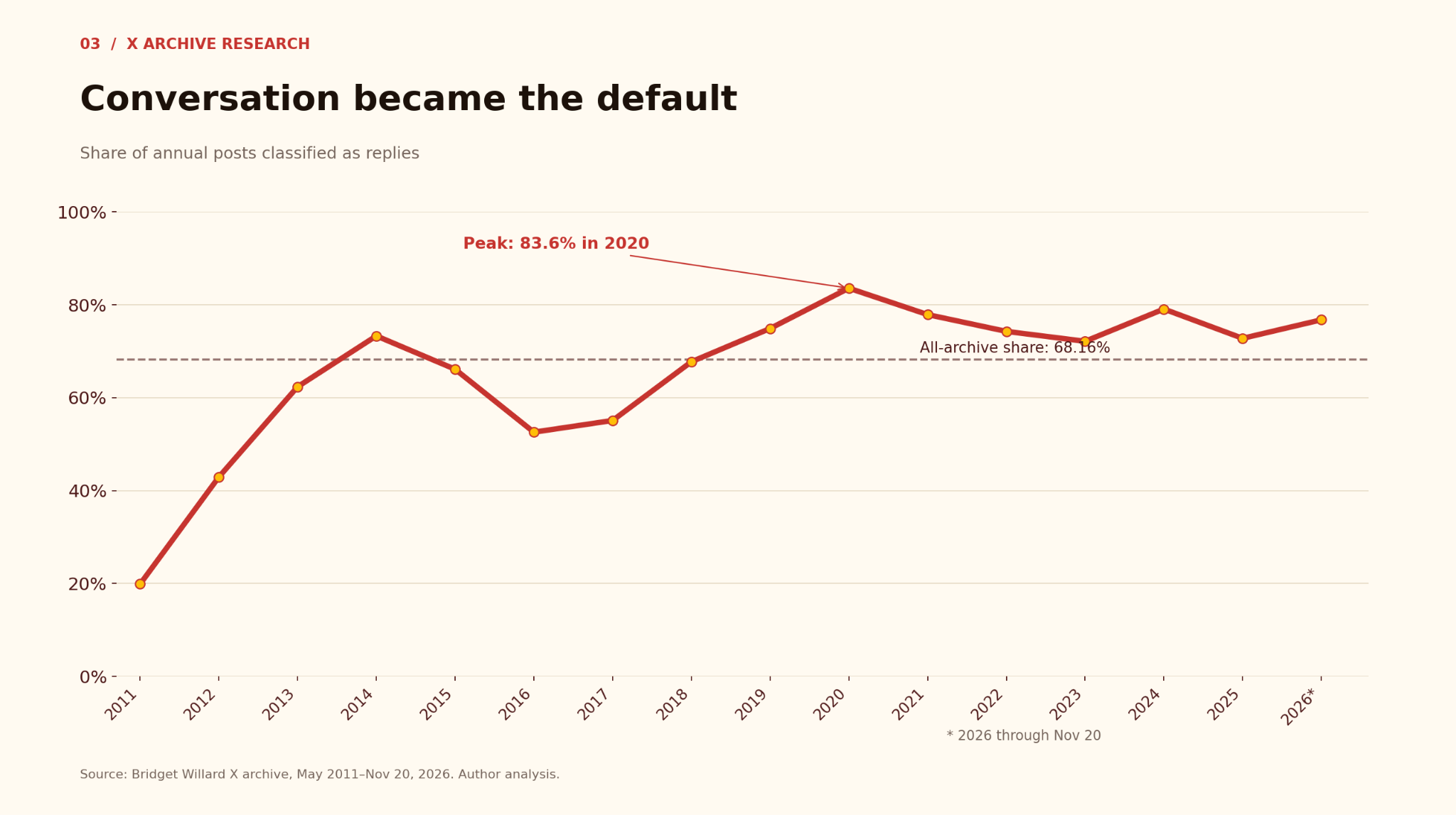
The reply share fluctuated thereafter, but conversation remained the majority of activity in every full year from 2013 onward.
The highest annual reply share occurred in 2020*, when 16,628 of 19,896 posts were replies, or approximately 83.6%.
This does not imply that 2020 was the most commercially productive year, nor does it establish why the activity increased.
*2020, as we all know, was the lockdown year and the year when Bridget Willard published 4 books.
It does establish that replies were not merely an incidental feature of the account.
Conversation became a persistent characteristic of its public activity.
What this means for SaaS marketing
Publishing original content remains useful. Companies need places to explain products, communicate positioning, distribute educational resources, and announce developments.
But original content need not represent the entirety of social media strategy.
Replies provide another form of market participation.
They allow a business to respond to questions where they arise, contribute expertise to existing discussions, acknowledge other professionals, and learn how people describe their experiences.
This suggests a practical distinction:
A publishing strategy asks, “What should we say today?”
A relationship-driven strategy also asks, “Which conversations should we participate in today?“
For SaaS companies, both questions deserve attention.
4. Finding Two: Relationships Extended Across Years
Reply volume explains how frequently an account participated in conversations.
It does not reveal whether those interactions were distributed evenly across thousands of accounts or concentrated among a smaller group of recurring relationships.
To examine this distinction, the archive’s available reply-target metadata was grouped by account and calendar year.
The dataset identifies approximately 11,181 distinct reply-target handles, excluding the account owner’s own handles.
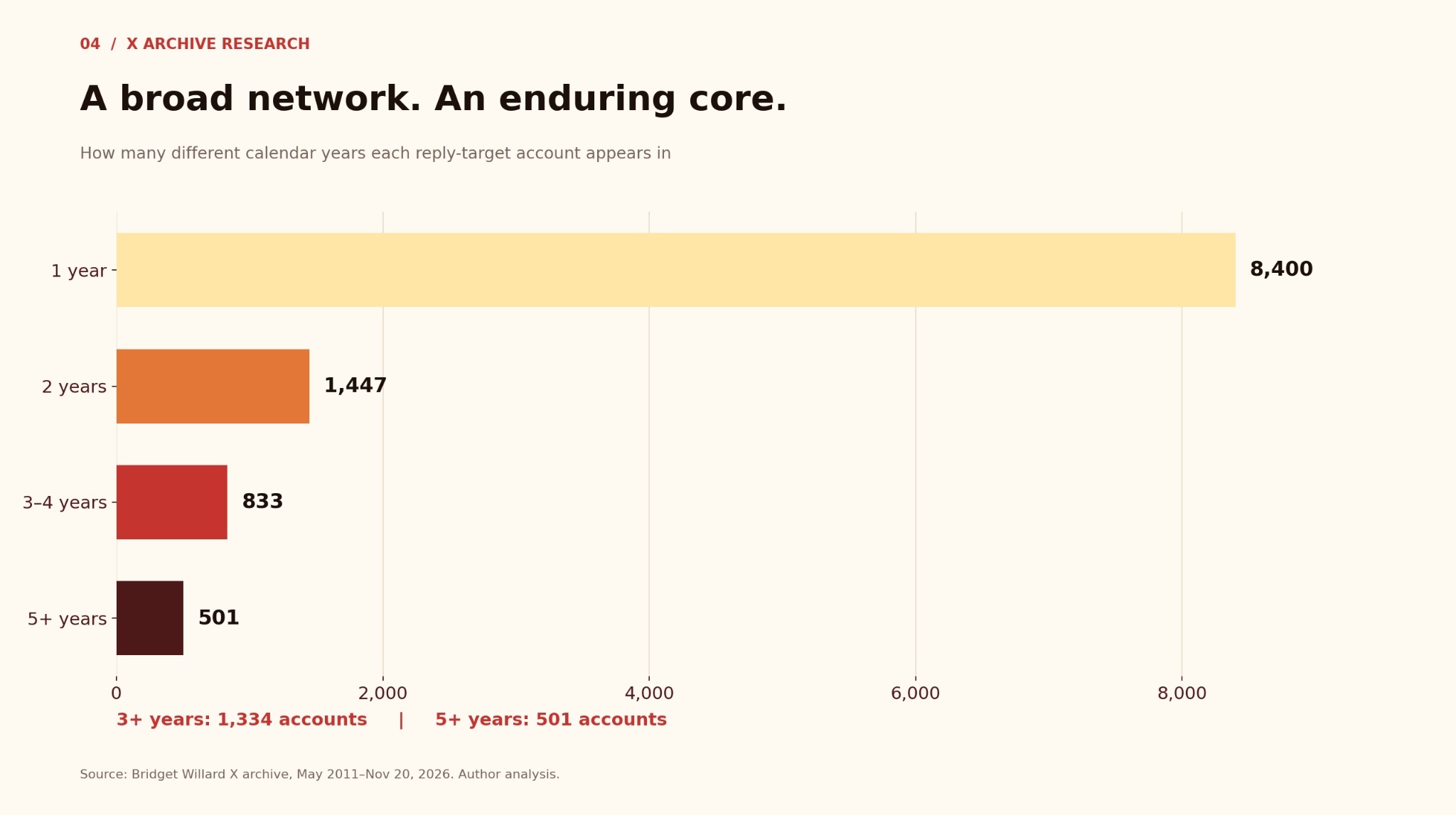
Among those targets:
- 1,334 appeared in at least three different calendar years.
- 501 appeared in at least five different calendar years.
- The 30 most-frequently replied-to accounts received 28,310 replies, approximately 21.7% of all recorded replies.
These figures require careful interpretation.
A reply target is not necessarily a customer, friend, business partner, or member of the ideal customer profile.
Multiple replies do not prove the other person responded.
And a conversation that persisted over years may have changed in character.
Nevertheless, the records demonstrate that a substantial proportion of activity involved recurring accounts.
The network was not composed exclusively of strangers encountered once.
Selected examples of persistence
| Account | Replies recorded | First to last reply | Calendar years |
| @Carol_Stephen | 5,374 | 2011–2026 | 16 |
| @WarrenLNaida | 5,091 | 2019–2026 | 8 |
| @rnissenbaum | 1,094 | 2015–2022 | 8 |
| @ToyotaEquipment | 980 | 2011–2021 | 11 |
| @FatDogCreatives | 879 | 2016–2024 | 9 |
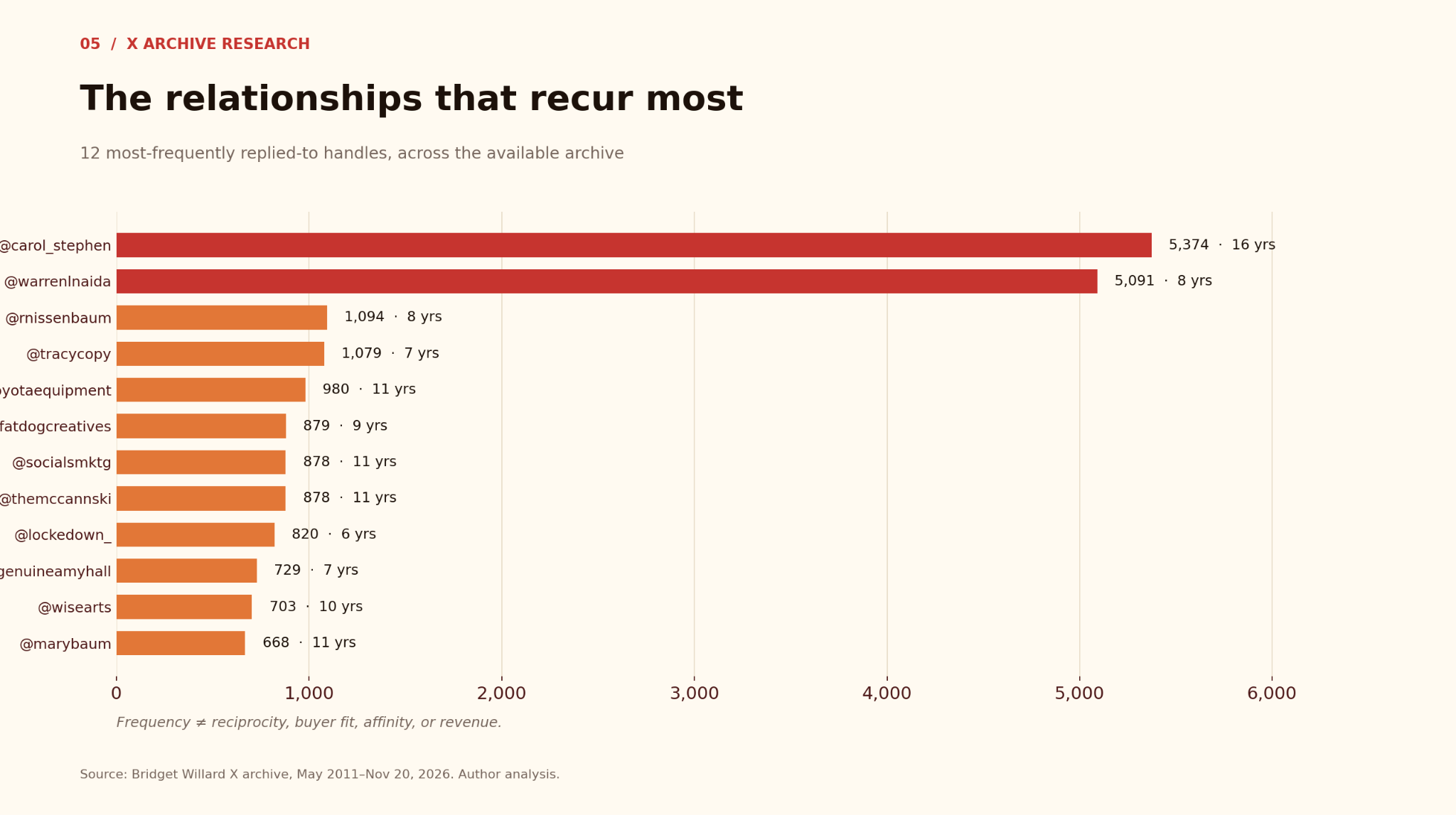
These examples reflect reply-target metadata in the archive. They do not establish reciprocity or commercial outcomes.
The significance lies in their duration.
The same platform on which a business announces a product update can also support recognizable patterns of professional participation over many years.
This matters because B2B opportunities often arise outside the exact moment a marketer publishes a promotional message.
A professional relationship may precede a referral, collaboration, consulting inquiry, or purchase by months or years.
The archive cannot establish the sequence or cause of every such event. It does, however, demonstrate that sustained relationships were a major part of the account’s public behavior.
Relationships Evolve, Not Just Accumulate
Longitudinal social media data can reveal when interactions begin, intensify, decline, or disappear. It cannot independently explain why.
Professional relationships change as people change careers, move between platforms, establish new priorities, or experience changes in their personal lives. Some connections become closer. Others become less active or end entirely.
For example, the archive documents recurring interaction with Robert Nissenbaum (@rnissenbaum) between 2015 and 2022. However, his subsequent transition away from marketing toward teaching ocean kayaking provides context that the historical reply counts alone cannot explain.
Similarly, Carol Stephen’s participation across multiple professional accounts, her movement to Bluesky, and the changing platform presence of #DigiBlogChat demonstrates that a relationship’s activity on one account or platform is not necessarily a complete record of its continuity.
These distinctions matter when interpreting relationship-driven marketing. A decline in public interaction should not automatically be classified as lost trust, diminished affinity, or an unsuccessful relationship.
Relationships are dynamic. Their relevance, frequency, and form change as the people involved change.
The objective of relationship-driven marketing is not to preserve every connection indefinitely. It is to develop genuine professional relationships, participate meaningfully while those relationships are relevant, and recognize that their value cannot be reduced to posting frequency.
Relationships do not have to produce immediate sales to matter
Conventional marketing dashboards tend to privilege actions that can be connected to a campaign: link clicks, form submissions, booked calls, or purchases.
Professional relationships do not always develop within that reporting structure.
- A developer may recommend a consultant to a founder.
- An agency owner may introduce a service provider to a client.
- An existing customer may publicly discuss a product.
- A conference connection may become a future collaboration.
These events should be documented when they occur, but their possibility is not a reason to attribute every interaction to revenue.
The more defensible observation is that long-term network participation can create opportunities for recognition and continued contact that a publishing calendar alone does not capture.
For SaaS marketers, relationship continuity deserves consideration alongside campaign performance.
5. Finding Three: Professional Positioning Evolved While Conversation Continued
The archive covers several distinct professional periods.
Early activity emphasized general social media discussion and networking.
As the account developed, WordPress, plugin businesses, content marketing, agency work, and software-related conversations became more visible.
By 2025 and 2026, explicit references to SaaS marketing, founders, business development, and current consulting services appeared more frequently.
This evolution is particularly important because it challenges the assumption that a professional must continually start over when changing positioning.
Early foundations: 2011–2015
A post dated July 26, 2011, stated:
“The word ‘media’ does not negate the social norms and behaviors in #socialmedia. We still expect tact, respect, and courtesy.”
The post is not evidence of a completed marketing framework. It is evidence of an early public emphasis on the interpersonal expectations surrounding social media.
The later archive demonstrates increasing conversational participation, suggesting that this perspective was accompanied by a change in observable posting behavior.
WordPress and professional communities: 2016–2021
Posts during this period frequently involved WordPress, plugins, agencies, content strategy, and marketing.
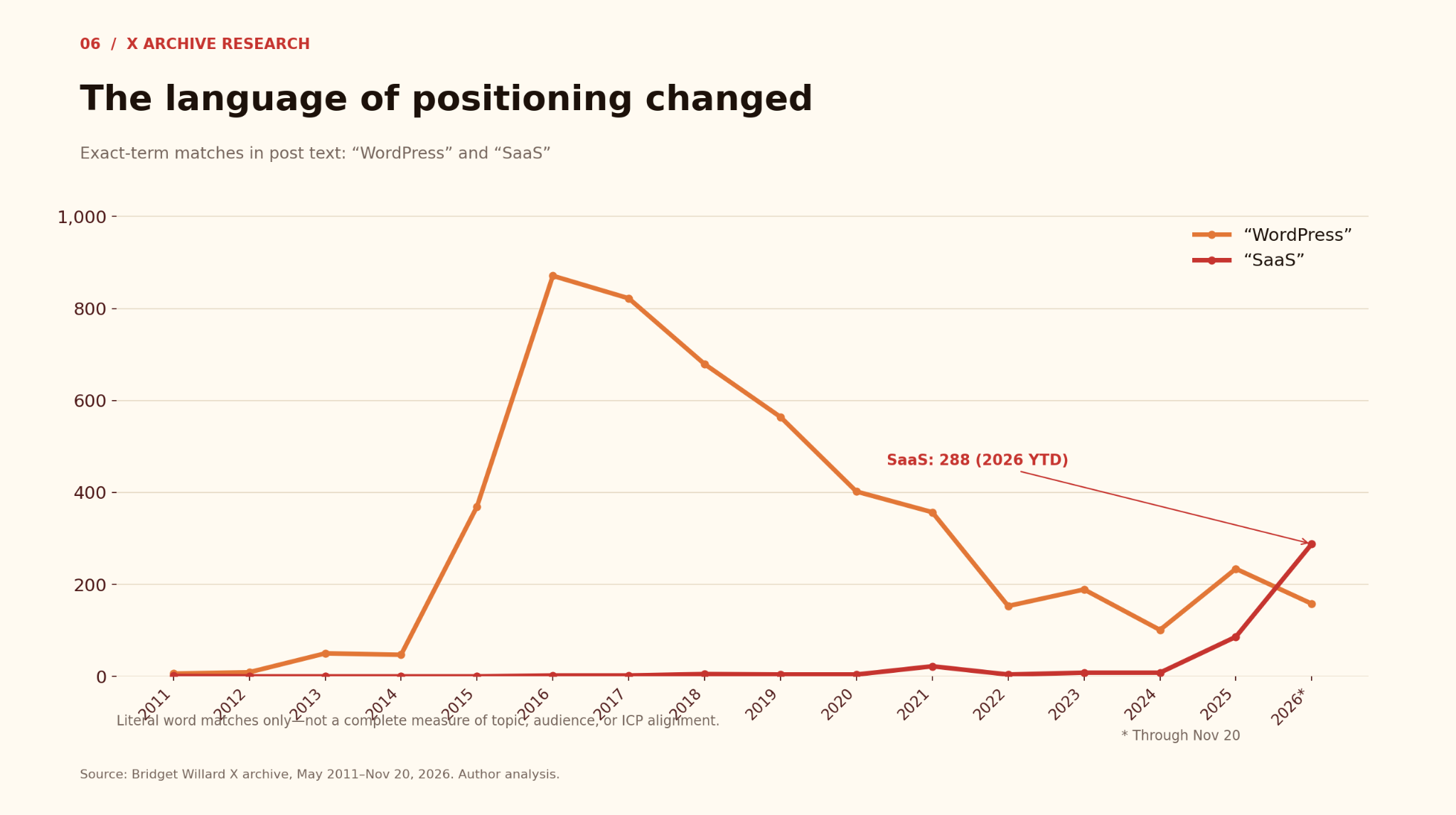
Explicit mentions of “WordPress” were particularly common between 2016 and 2019. The context of which was the traveling that clients paid me to do to WordCamps (WordPress Conferences) and subsequent live tweeting. The COVID-19 lockdown and pandemic changed the landscape of event marketing in WordPress, which still occurs, but less frequently.
Across those four years, the archive contains 2,936 posts matching that standalone term.
This reflects a period in which participation in the WordPress ecosystem was prominent in the account’s public content.
It does not measure every WordPress-related conversation, because users frequently discuss companies, plugins, and technical subjects without naming WordPress explicitly.
Nevertheless, the record demonstrates sustained participation in a recognizable professional community.
That community included people who build, sell, market, maintain, and recommend software.
In other words, it represented an ecosystem with substantial overlap between technical expertise, agency relationships, product businesses, and future business-development opportunities.
Evidence of commercial activity before the SaaS repositioning
The archive also contains direct promotional messaging during earlier professional periods.
For example, on December 9, 2019, Willard publicly announced availability for two additional monthly Twitter clients and offered an introductory discount.
This establishes that direct commercial promotion existed alongside conversational participation.
The account was not exclusively social or exclusively educational.
It combined interaction, professional visibility, content distribution, and offers for paid services.
The frequency, timing, and effectiveness of those offers require further analysis.
Explicit SaaS positioning: 2025–2026
The account’s language changed as its business focus became more explicitly SaaS-oriented.
A case-insensitive search for the standalone term “SaaS” returned 86 matching posts in 2025 and 288 in the available 2026 records, compared with comparatively few matches in most earlier years.
This is a narrow keyword measurement rather than a complete topic analysis. It excludes discussions of software businesses that do not use the term.
Even with that limitation, the increase indicates a clear shift in explicit positioning.
By November 2026, Willard described audience selection as part of her strategy.
In a November 20 post, she wrote:
“Who I reply to is part of the strategy.”
This statement is a firsthand explanation of her marketing intent.
The archive supports the existence of recurring professional engagement, while the precise degree of ideal customer profile alignment remains a separate empirical question.
The business implication
A mature professional network does not have to be discarded when a company changes its positioning.
Existing relationships with agencies, developers, marketers, product professionals, and consultants may continue to be relevant to a new offer.
For SaaS founders, the lesson is not to build the largest possible network.
It is to participate consistently in the professional ecosystem surrounding the product and its customers.
That ecosystem may remain valuable as the company changes its messaging, pricing, product offering, or target market.
6. The Missing Variable: Who You Engage With
One of the limitations of evaluating X performance through engagement counts is that interactions are not commercially equivalent.
A reply to an ideal customer, a colleague, a referral partner, an existing client, and an unrelated account may all count as one reply.
But the relationships have different strategic functions.
This difference is central to relationship-driven B2B marketing.
The ideal customer profile is not the entire relevant audience
An ideal customer profile identifies the type of organization most likely to benefit from and purchase a company’s offering.
For a SaaS business, that profile may include industry, company size, operational challenges, buying authority, technology requirements, and budget.
However, people outside the direct buying group can influence how a product is discovered, evaluated, and recommended.
Consider the professional ecosystem surrounding a WordPress software company.
Its relevant audience may include website agencies, freelance developers, hosting providers, product educators, consultants, integration partners, and existing customers.
Not all of those people purchase the software directly.
Some recommend tools to clients. Others troubleshoot customer problems, publish tutorials, introduce founders to potential partners, or shape professional discussions about product choices.
A marketing strategy concerned only with direct purchasers may overlook these relationships.
Five relationship categories
A useful B2B audience framework distinguishes:
Prospective customers: People or organizations with a plausible commercial need for the offering.
Existing customers: People whose experiences contribute to retention, support, advocacy, and future recommendations.
Referral partners: Professionals who may introduce the business to qualified buyers.
Industry peers and collaborators: People who contribute expertise, market context, visibility, and partnership opportunities.
Broader community members: People who participate in relevant conversations without a known direct commercial relationship.
These categories are not mutually exclusive.
An agency owner might be a customer, referral partner, and collaborator at different times.
A developer might become a SaaS founder.
A former client might later introduce a consultant to another company.
This is why audience selection cannot be evaluated using job titles alone.
Relationship context matters.
What the archive shows—and what it does not
The archive identifies who received replies, when those replies occurred, and what the account owner wrote.
Those records can be used to investigate whether recurring targets belong to relevant business communities.
However, they do not consistently provide independently verified occupations, buying authority, company ownership, or commercial relationships.
Therefore, this study does not assign an ideal customer profile percentage to all 130,271 replies.
Doing so without verifying the accounts would give the appearance of precision without sufficient evidence.
Instead, the archive supports a clear distinction between two separate dimensions of social media strategy:
Engagement behavior: How a business participates in conversations.
Audience alignment: Whether those conversations involve people relevant to its commercial ecosystem.
An effective B2B approach needs both.
A company can engage thoughtfully with the wrong audience and still struggle to develop qualified opportunities.
Likewise, it can identify the right prospects but fail to become recognizable because it rarely participates in their conversations.
The strategic challenge is to connect relevance with genuine participation.
7. Recognition → Trust → Sales
The findings can be interpreted through Bridget Willard’s established relationship-driven marketing framework:
Recognition → Trust → [Affinity → Loyalty →] Sales
The framework describes how familiarity and ongoing relationships may contribute to commercial opportunities.
It is not a promise that every interaction becomes a sale.
It also should not be interpreted as a rigid sequence in which every person moves through the same stages at the same speed.
Recognition
Recognition begins when people become familiar with a person, company, or product.
Social media creates opportunities for repeated encounters through posts, replies, reposts, mentions, and conversations.
The archive provides direct evidence of recurring public activity and repeated contact with identifiable accounts.
However, it cannot determine whether every recipient noticed or remembered those interactions.
Recognition is therefore an opportunity supported by repeated exposure, not an outcome automatically established by posting frequency.
Trust
Trust involves confidence in a person’s or company’s competence, reliability, honesty, or judgment.
Useful public contributions may support trust by making expertise observable.
A SaaS founder who consistently explains product decisions, responds constructively to questions, and acknowledges limitations gives an audience more information with which to evaluate the company.
A reply that helps someone solve a problem may contribute more to professional credibility than a generic claim of expertise.
Still, trust is ultimately a judgment made by another person.
It cannot be measured from reply counts alone.
Affinity
Affinity is a substep in Recognition, Trust, Sales, that comes after Trust and involves positive associations, shared interests, and a preference for continued connection.
Humor, encouragement, professional curiosity, appreciation, and personal conversation can contribute to affinity.
The archive contains many examples of informal exchanges alongside professional discussions.
These interactions demonstrate that the account’s public behavior was not confined to sales messaging.
But an individual’s feelings toward another participant cannot be inferred conclusively from the account owner’s own words.
Loyalty
Loyalty is the second substep in Recognition, Trust, Sales, that follows Affinity, and involves a continuing relationship that persists through time and experience.
The archive’s multi-year reply patterns are consistent with ongoing contact.
Some accounts appear across many calendar years, demonstrating that interaction did not end after an initial exchange.
Yet loyalty requires more than repeated exposure.
Customer retention, ongoing referrals, repeat purchases, or independently documented relationship behavior would provide stronger evidence of this stage.
The historical archive captures part of that story, not all of it.
Sales
Sales occur when a commercial need, appropriate offering, decision-making process, and sufficient confidence align.
The archive includes direct marketing offers and public references to consulting services.
It also documents participation in professional networks where future opportunities could arise.
However, it does not provide a complete record of leads, contracts, invoices, or revenue.
Accordingly, the study does not claim that the account’s 130,271 replies generated a specific monetary return.
The framework offers a strategic explanation for why relationships matter. Commercial attribution requires additional evidence.
The important distinction is that the framework is an approach to developing business relationships, not a mathematical formula for converting replies into revenue.
8. X as Off-Page SEO: Beyond Search Rankings
Willard has described X as off-page search engine optimization.
The phrase is useful when understood as a broader visibility and discoverability strategy rather than a claim that social media replies directly increase Google rankings.
Search visibility is not limited to the technical performance of a company’s own website.
People discover brands through professional recommendations, social discussions, communities, podcasts, articles, and conversations with trusted peers.
A software buyer may encounter a company in a public discussion, hear about it from an agency partner, visit its website later, and eventually initiate a sales conversation.
A conventional attribution report may credit the final website visit while overlooking the earlier professional exposure.
That does not mean every social interaction influenced the purchase.
It means the buying journey can involve contacts and contexts that are difficult to capture using a single referral source.
Social conversations as market intelligence
X also gives SaaS companies opportunities to observe how people discuss products and problems in their own words.
Potentially useful questions include:
- What frustrates customers about existing tools?
- Which technical problems are difficult to explain?
- What language do users employ when describing their needs?
- Which objections repeatedly appear?
- What do agencies recommend, and why?
- What assumptions do prospective buyers make about a product category?
These observations can inform product messaging, website content, articles, documentation, and sales enablement.
A company that participates in the relevant community may discover questions that would not have appeared in an internal content-planning meeting.
This is a different form of value from impressions or direct website referrals.
It connects social participation to broader marketing judgment.
The boundary of the claim
This study does not measure improvements in search rankings caused by X conversations.
It does not demonstrate that a particular reply generated a backlink or increased organic search traffic.
Instead, it identifies a complementary off-site marketing function: developing visibility, recognition, and professional connections beyond the company’s owned website.
The potential SEO relationship should be evaluated through separate evidence, including search demand, third-party mentions, referral behavior, and other measurable outcomes where available.
9. What SaaS Founders Can Replicate
The purpose of this case study is not to encourage founders to publish 191,138 posts.
That would confuse the research subject’s historical activity with a recommended operating target.
Nor does the evidence establish 68% as an optimal reply ratio.
The transferable lessons concern how businesses organize their attention, contribute to relevant discussions, and maintain professional relationships.
Principle 1: Define the ecosystem before building the calendar
Start by identifying the people who influence product discovery and purchasing decisions.
Include customers, prospects, referral partners, agencies, consultants, educators, and adjacent professionals.
A founder selling a developer tool needs a different network from a founder selling software to compliance teams.
The audience should reflect the product’s commercial environment.
Principle 2: Listen before prescribing content
Observe the discussions already taking place.
Find recurring questions, misconceptions, implementation challenges, industry disagreements, and customer concerns.
Use what you learn to inform your publishing strategy.
A content calendar becomes more useful when it reflects genuine market conversations rather than assumptions about what people want to read.
Principle 3: Contribute where your expertise is relevant
Not every useful contribution requires a link, a product mention, or a sales pitch.
- Answer questions.
- Explain tradeoffs.
- Share examples.
- Offer context.
A SaaS company can demonstrate competence through how its people participate in public discussions.
The objective is to be useful and credible, not to manufacture a reason to mention the product.
Principle 4: Maintain relationships beyond the first interaction
A single reply may create an introduction.
Recurring participation creates opportunities for greater familiarity.
Notice when people return to relevant topics. Recognize their work. Follow up on conversations. Continue professional relationships without treating every exchange as a lead-generation event.
The historical research demonstrates that sustained interaction is possible across many years.
It does not establish that every such relationship is commercially valuable, but it shows why relationship continuity deserves attention.
Principle 5: Include referral partners in audience strategy
An ideal customer profile is necessary, but it is not sufficient for understanding the entire professional network surrounding a SaaS purchase.
Identify people who advise, implement, integrate, recommend, or educate within the product category.
Their roles may make them important participants in the company’s market even when they are not direct customers.
Referral relationships should be genuine, appropriate, and based on professional relevance rather than transactional expectations.
Principle 6: Use human communication without abandoning professional relevance
The archive contains personal acknowledgments, humor, questions, professional observations, and commercial messages.
This mixture reflects an account operated through a recognizable human voice.
SaaS founders do not need to imitate that particular personality.
They do need to consider whether their communication gives people a meaningful reason to respond.
A corporate account can be professional without being impersonal.
Principle 7: Make relevant offers
Relationship-driven marketing is still marketing.
When someone expresses a need that a company can address, an appropriate offer can be helpful.
The critical distinction is relevance.
A commercial recommendation should respond to the context of the conversation rather than interrupt it.
Companies should make it easy for interested people to learn about their services, without treating every social interaction as permission to pitch.
Principle 8: Measure relationships alongside content performance
A reporting dashboard should include more than publishing activity.
Potential measures include:
- Number of substantive interactions with relevant industry accounts.
- Recurring conversations with prospective customers and referral partners.
- Qualified introductions or inbound inquiries.
- Customer questions that inform documentation or content.
- Collaborations and publicly attributable recommendations.
- Meetings, opportunities, and sales where records support attribution.
These measurements require definitions and disciplined recordkeeping.
They should complement conventional social metrics rather than replace them.
The objective is not to turn every relationship into a number.
It is to avoid measuring the entire strategy through numbers that describe only content distribution.
10. A Practical 90-Day Relationship-Driven Marketing Pilot
A SaaS company does not need to imitate 15 years of activity to test whether relationship-driven participation belongs in its marketing strategy.
A 90-day pilot can establish a manageable process and generate initial observations.
The following is a proposed implementation model, not a process whose effectiveness was demonstrated by the archive.
Days 1–30: Understand the market
Document the ideal customer profile and relevant referral ecosystem.
Identify professional communities and recurring conversations connected to customer problems.
Review existing account activity to understand who is already engaging with the brand.
Participate selectively in discussions where the team can contribute relevant expertise.
Record common questions and themes that could improve website messaging or content.
Days 31–60: Build recognizable participation
Maintain consistent involvement in relevant conversations.
Publish original content informed by observed customer questions.
Recognize recurring accounts and continue discussions where there is a legitimate reason to do so.
Avoid substituting superficial replies for substantive participation.
Track whether relevant accounts begin appearing repeatedly in the company’s conversations.
Document collaboration opportunities or introductions without assuming that every interaction represents a lead.
Days 61–90: Evaluate business relevance
Review the relationships and discussions developed during the pilot.
Identify whether the team has increased its participation in communities relevant to customers and partners.
Examine any resulting inquiries, introductions, meetings, referrals, or opportunities.
Document what can and cannot be attributed to X.
Compare the insights collected from conversations against the company’s existing content strategy.
Decide which activities merit continuation, modification, or discontinuation.
What success might look like
Early success may include a clearer understanding of customer concerns, increased interaction with relevant industry participants, or opportunities for meaningful follow-up.
Commercial success requires documented business outcomes.
A 90-day pilot should not promise immediate sales, particularly when software buying decisions involve lengthy evaluation cycles.
Its purpose is to determine whether the company’s participation is becoming more relevant, sustainable, and connected to identifiable business objectives.
11. Implications for B2B Marketing Measurement
The archive’s most significant contribution is not a universal prescription for how often to reply.
It is evidence that sustained conversational activity can represent a major portion of a professional’s social media presence.
This raises a measurement problem.
Marketing dashboards often make original posts, impressions, followers, and clicks highly visible.
The continuity of relationships is harder to capture.
A simple reply count cannot distinguish a conversation with an existing customer from a conversation with an unrelated account.
An engagement report may overlook whether a software founder is becoming familiar to agency owners who influence purchasing decisions.
A referral may occur months after the public interaction that helped establish the relationship.
These limitations do not justify abandoning quantitative reporting.
They suggest that B2B reporting should distinguish three categories of evidence.
Activity metrics
What did the company do?
Examples include publishing, replying, sharing, and participating in discussions.
Relationship and audience metrics
Who was involved, and how relevant were those interactions?
Examples include recurring participation with verified target accounts, referral partners, customers, and professional communities.
Business outcomes
What documented commercial results followed?
Examples include qualified inquiries, introductions, meetings, opportunities, sales, and retention.
A business should not confuse one category with another.
High activity is not proof of strong relationships.
Strong relationships are not automatically proof of revenue.
And revenue attribution should not be invented when the evidence is unavailable.
A useful B2B social media strategy acknowledges these distinctions while seeking to connect them through better research and recordkeeping.
12. Conclusion: Relationships Are Not a Byproduct of Marketing
The 15-year X archive examined in this study documents 191,138 unique posts, including 130,271 replies.
It shows that conversation became the dominant form of account activity and remained so across multiple professional periods.
It also identifies substantial multi-year interaction with recurring accounts, including more than 500 accounts appearing as reply targets in five or more calendar years.
The account owner’s professional positioning evolved from broader social media and WordPress community participation toward more explicit SaaS-focused marketing and business development.
The evidence is substantial enough to establish long-running behavioral patterns.
It is not sufficient to claim that conversation volume caused particular sales outcomes or to prescribe a universal formula for other businesses.
The practical implications are nevertheless meaningful.
SaaS companies should consider social media as more than a channel for distributing content.
It is also an environment in which customers ask questions, professionals exchange expertise, relationships continue, and opportunities may emerge.
To participate effectively, businesses need to understand both the conversations and the people involved.
They need to recognize that direct buyers are only one part of a broader professional ecosystem.
And they need to measure their work in ways that distinguish activity, audience relevance, relationships, and commercial outcomes.
A content calendar can help a company maintain consistency.
But consistency alone does not determine whether the right people are becoming familiar with the business.
That requires participation, judgment, relevance, and sustained attention.
The objective is not simply to be seen. It is to become known, trusted, remembered, and recommended by the people who matter to your business.
About Bridget Willard
Bridget Willard is a SaaS marketing consultant, author, and speaker who helps software companies develop audience recognition, professional relationships, and stronger marketing communication.
Her work combines social media strategy, audience intelligence, content marketing, and business development, with a particular focus on X and its role in professional communities.
She is the founder of Bridget Willard, LLC, and the author of How to Market Your Plugin: A Framework for the Sleep-Deprived Developer.
Her marketing approach is grounded in the principle that recognition precedes trust and that relationships contribute to long-term commercial opportunities.
Website: https://bridgetwillard.com
X: https://x.com/BridgetMWillard
For SaaS marketing strategy and consulting services, visit https://bridgetwillard.com.
Research Appendix
A. Data provenance
The primary source is an X account archive obtained by Bridget Willard in November 2026.
Four original JavaScript tweet files were processed into structured tabular data. Records were deduplicated by post identifier.
The analysis includes 191,138 unique records dated between May 18, 2011, and November 20, 2026.
No duplicate post identifiers were identified.
B. Classification
Reply: A post classified from available reply metadata.
Original or quote post: A record not classified as a reply or repost. The extraction process did not reliably distinguish all quote posts from standalone originals.
Repost: A record identified by the RT attribution pattern.
Recurring reply target: An account appearing in the reply-target metadata in more than one calendar year.
Multi-year persistence: The number of distinct calendar years containing at least one recorded reply to a particular account.
SaaS keyword mention: A case-insensitive match for the standalone word “SaaS.” This is not a comprehensive topic classifier.
C. Quantitative findings
| Measure | Result |
| Total archived posts | 191,138 |
| Replies | 130,271 |
| Reply proportion | 68.16% |
| Original or quote posts | 54,818 |
| Reposts | 6,049 |
| Distinct reply-target handles | Approximately 11,181 |
| Accounts replied to in 3+ calendar years | 1,334 |
| Accounts replied to in 5+ calendar years | 501 |
| Replies to 30 most-frequent targets | 28,310 |
| Share of replies to top 30 targets | 21.7% |
| Highest recorded annual reply share | 83.6%, in 2020 |
| Duplicate post identifiers | 0 |
Counts involving reply-target accounts are dependent on available metadata, historical handle consistency, and normalization.
D. Selected source examples
Early social media philosophy, July 26, 2011:
https://x.com/BridgetMWillard/status/95913115404865536
Direct consulting promotion, December 9, 2019:
https://x.com/BridgetMWillard/status/1204069897103462400
Audience selection as an explicit strategy, November 20, 2026:
https://x.com/BridgetMWillard/status/2123586875999011047
Contextual product-marketing advice, November 20, 2026:
https://x.com/BridgetMWillard/status/2123827315369296267
Contextual book recommendation, November 20, 2026:
https://x.com/BridgetMWillard/status/2123829881335332959
These links identify posts in the supplied archive. Their availability on the live X platform and full surrounding conversation context may vary.
E. Research limitations
This study is based on a single account and should not be generalized to all SaaS companies without comparative research.
The archive records activity authored by the account owner, not a complete history of other participants’ behavior.
It does not directly measure trust, affinity, loyalty, individual recognition, or sales causation.
Historical account handles have changed. This account started as @YouTooCanBeGuru. Author began using Twitter in March 2007 as @Gidgey. Deleted posts, incomplete reply metadata, and missing external conversation context may affect interpretation.
Archive engagement counts do not provide a complete basis for measuring impressions, reach, or conversion performance.
Professional audience classifications and client relationships require independent verification when used as evidence of commercial outcomes.
The research is descriptive rather than causal.
F. Additional research opportunities
Further investigation could classify a representative sample of reply recipients according to verified professional roles and commercial relevance.
It could examine recurring conversations through complete public threads where accessible.
It could also compare documented introductions, client records, referral histories, and commercial outcomes with corresponding periods of public X activity.
A separate comparative study could examine whether similar relationship-driven patterns occur among other successful B2B and SaaS accounts.
These investigations would help distinguish individual historical behavior from generalizable marketing practices.
Copyright © 2026 Bridget Willard, LLC. All rights reserved.
Research based on a historical X archive covering May 2011–November 2026. Quantitative findings reflect the available dataset and the classification methods described above.