Category: Content Marketing

  • Why SaaS Founders Should Publish Articles on LinkedIn

    Why SaaS Founders Should Publish Articles on LinkedIn

    B2B SaaS Founders are often overwhelmed with their own workload as CEO, CFO, and CIO. Taking the time to publish on LinkedIn seems frivolous in comparison. But it’s crucial to brand building which is vital for sales. 

    Also, if you’re taking the time to post on LinkedIn about your company, you may as well also publish an article there as well.

    Why should you make time out of your busy schedule to publish on LinkedIn? 

    The short answer is for visibility, thought leadership, brand authority, and off-page SEO.

    Building Visibility On LinkedIn

    If you’re a B2B founder, CEO, or Marketer, you need to be on LinkedIn. It’s not outdated, it’s not becoming Facebook. It’s where people network online. CEOs aren’t typically in Reddit looking for customers and investors. 

    Networking on LinkedIn as an intentional exercise (even before and after conferences) is a great way of making it easier to hold meaningful conversations in person. Over 60% of the audience on LinkedIn depends on it for “event information and company news,” reports Statista

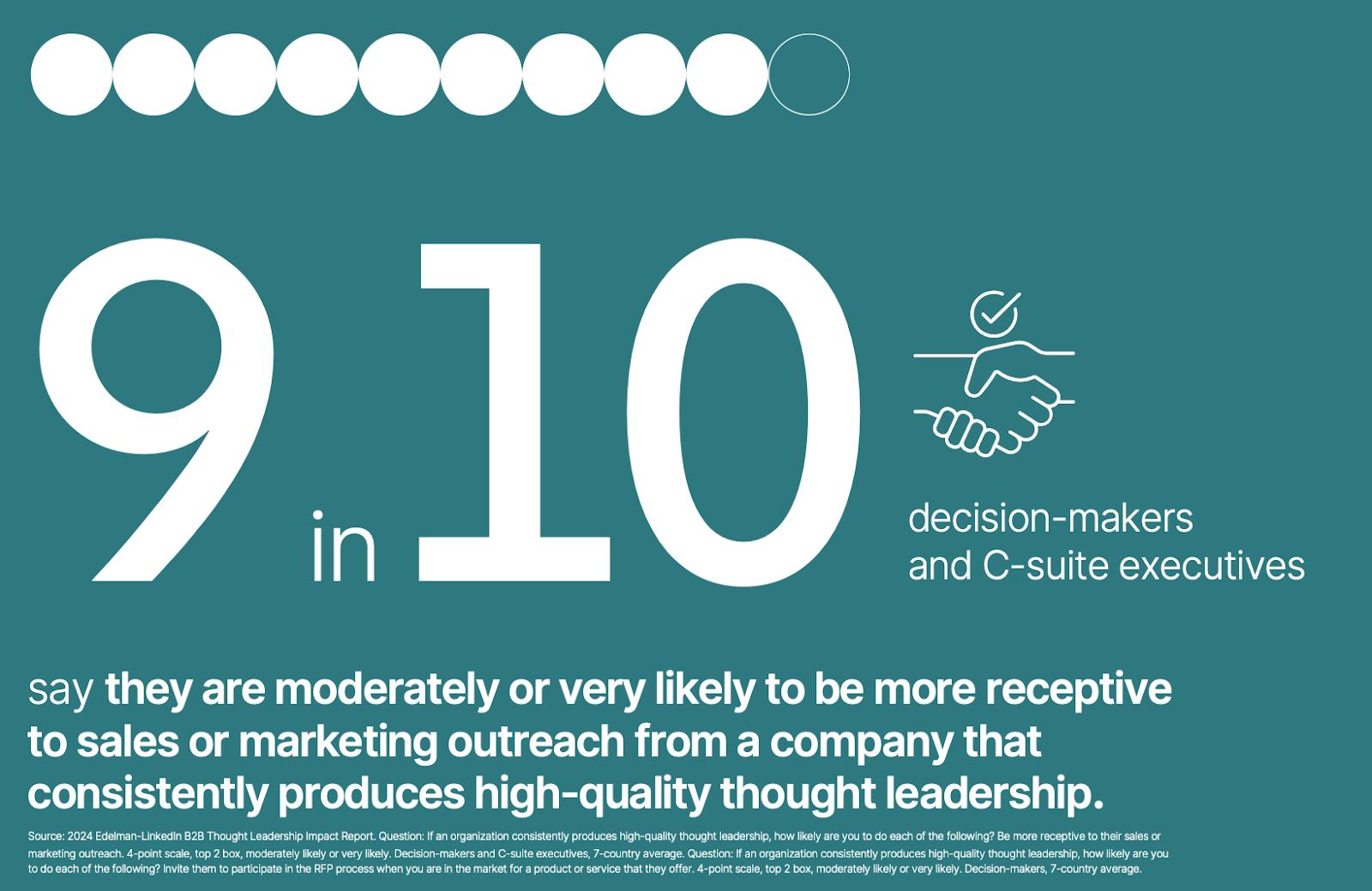
    Visibility that makes the sales process easier? Yes, please! Even better, 90% of the decision makers and C-Suite who consistently read your content are obviously more interested in a sales pitch. Warming up leads by publishing articles on LinkedIn seems like a no brainer.

    9 in 10 decision makers and C-suite executives say they are moderately or very likely to be more receptive to sales or marketing outreach from a company that consistently produces high-quality thought leadership.”   2024 Edelman-LinkedIn B2B Thought Leadership Impact Report
    AD 4nXfOtJFYOJj02NngYiz79Cj7JgM 82P2eSoDwE9Su42n0lDlAMiZKfw6rerfdXLZHFUsWBqG7DEmz4U5sK14kpzQl9mPPSyiBqjlhlMSKsK7UDCXfjaOj2cuClMNqhc6LcKbUB0laA?key=LX3OMp2bcEXdRL5t CpNR8zy

    2024 Edelman-LinkedIn B2B Thought Leadership Impact Report

    Building Thought Leadership on LinkedIn

    If you knew that over 50% of decision makers and C-Suite members spend over an hour a week reading thought leadership articles, would you change your strategy? It’s important to post consistently in order to break through the noise.

    “Aim for five LinkedIn posts per week, creating a steady rhythm of content.” EverythingDesign

    And while you’re doing that be sure to form new connections and reply to other people’s posts. You can easily fit this into your schedule with my 3-2-1 Method.

    “54% say the piece of thought leadership got them to realise there were other suppliers they could work with that had a better understanding of the challenges their organisation was facing.” Di Mace

    Building Brand Authority on LinkedIn

    Building brand authority on LinkedIn is important for any business; for startup SaaS companies – it’s crucial. You’ve built the Uber for [Industry] or the Google for [Industry]. People have to both want a new solution and know you exist

    Writing about problems that customers actually have? That’s the way to get it done. In fact, all of a SaaS founder’s posts on LinkedIn should inform website content, email marketing campaigns, and sales decks. Why? Because it’s the current thinking. Be sure to include as much data as possible, too.

    “Effective thought leadership has three key attributes: it cites strong research and data, helps buyers understand their business challenges, and offers concrete guidance.” Edelman

    Jonathan Kazarian, CEO of Accelevents (former client) is one to watch in the brand authority space.

    He consistently posts insights for the event marketing space as well as insights into their platform adoption. The best part is that he extracts insights for other founders. This kind of vulnerability is compelling for decision makers as well. 

    In this post, for example, he writes:

    “Over the past 12 months, our average deal size has grown by 113% while win rates have increased from 54% to 58%.”

    He goes on to cite learnings and how it has helped their ten-year Event Platform to start custom implementations. He ends with: 

    “The future of enterprise tech is Software & Service. That’s what we are building for.”

    We often talk about Software as a Service (SaaS) and forget about the service. This right here hits decision makers. It’s enough to make them change. And Jonathan (or a marketing exec on his behalf) could easily convert these long-form posts on LinkedIn into LinkedIn Articles. 

    Building Off-Page SEO on LinkedIn

    One of my favorite SEO tools is Google Alerts for my name, “Bridget Willard.” I set them for “as-it-happens” and “all results.” For the last couple of years, even posts on LinkedIn have been ranking and this helps me keep tabs of any mentions as well. 

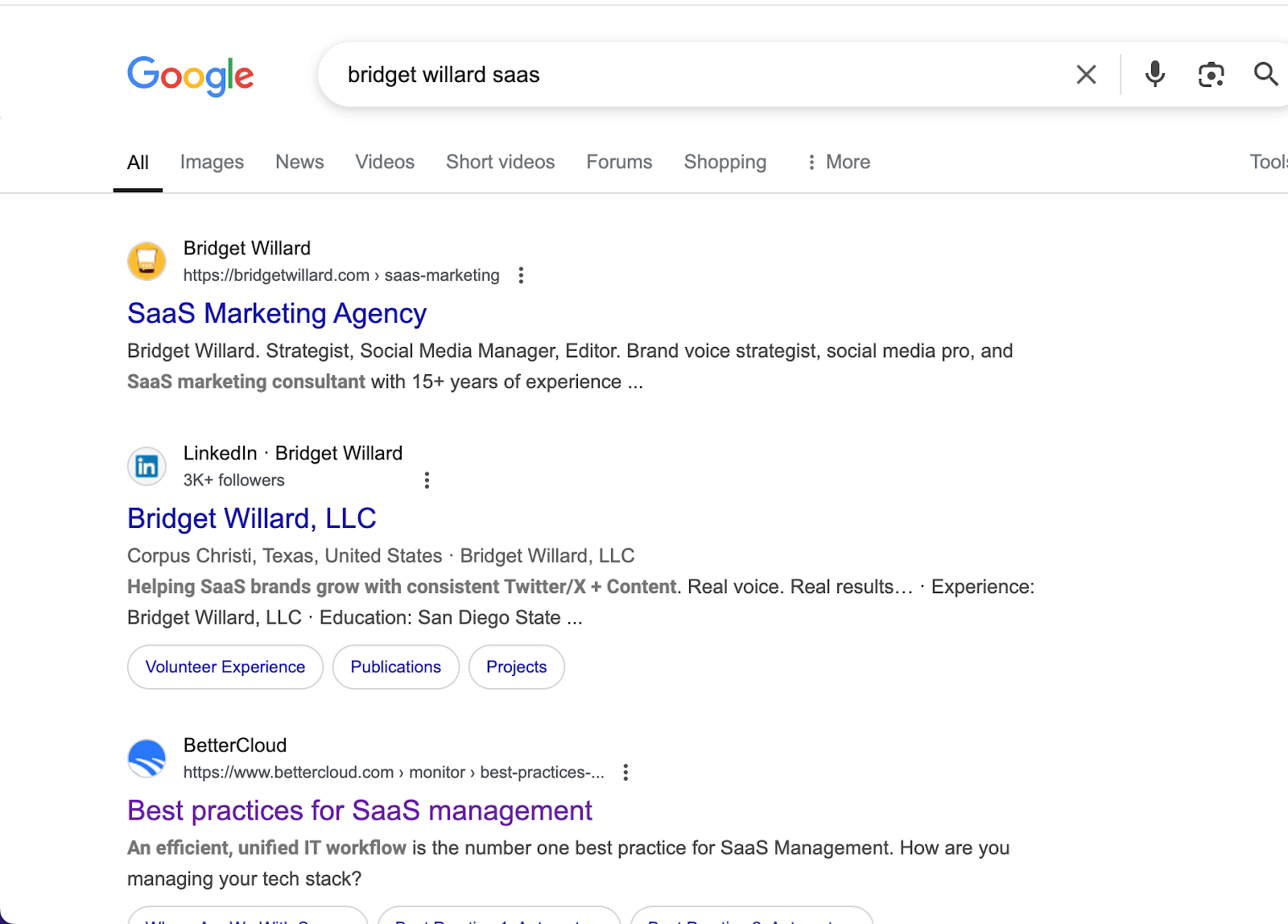
    A simple “Bridget Willard SaaS” search shows my website first, then my LinkedIn profile, then an article I wrote for BetterCloud – a SaaS Management Platform. Incognito results were similar. The BetterCloud article was number 5 in the SERPS with my X profile (3)  and Instagram profile (4) both ahead of it.
    AD 4nXct1YuTs7R6nPVeKWYREDbDB vg0DgVu4EXQy3sRFJyt05 zgL5EUjHg0uRCqcIdhSf 34nbMJ4ePdwqou2 Y9uYs3TRf6xJOsyVQ6I tL7IGXuAfmGgH noz8UGggjvHRKo 8qQ?key=LX3OMp2bcEXdRL5t CpNR8zy

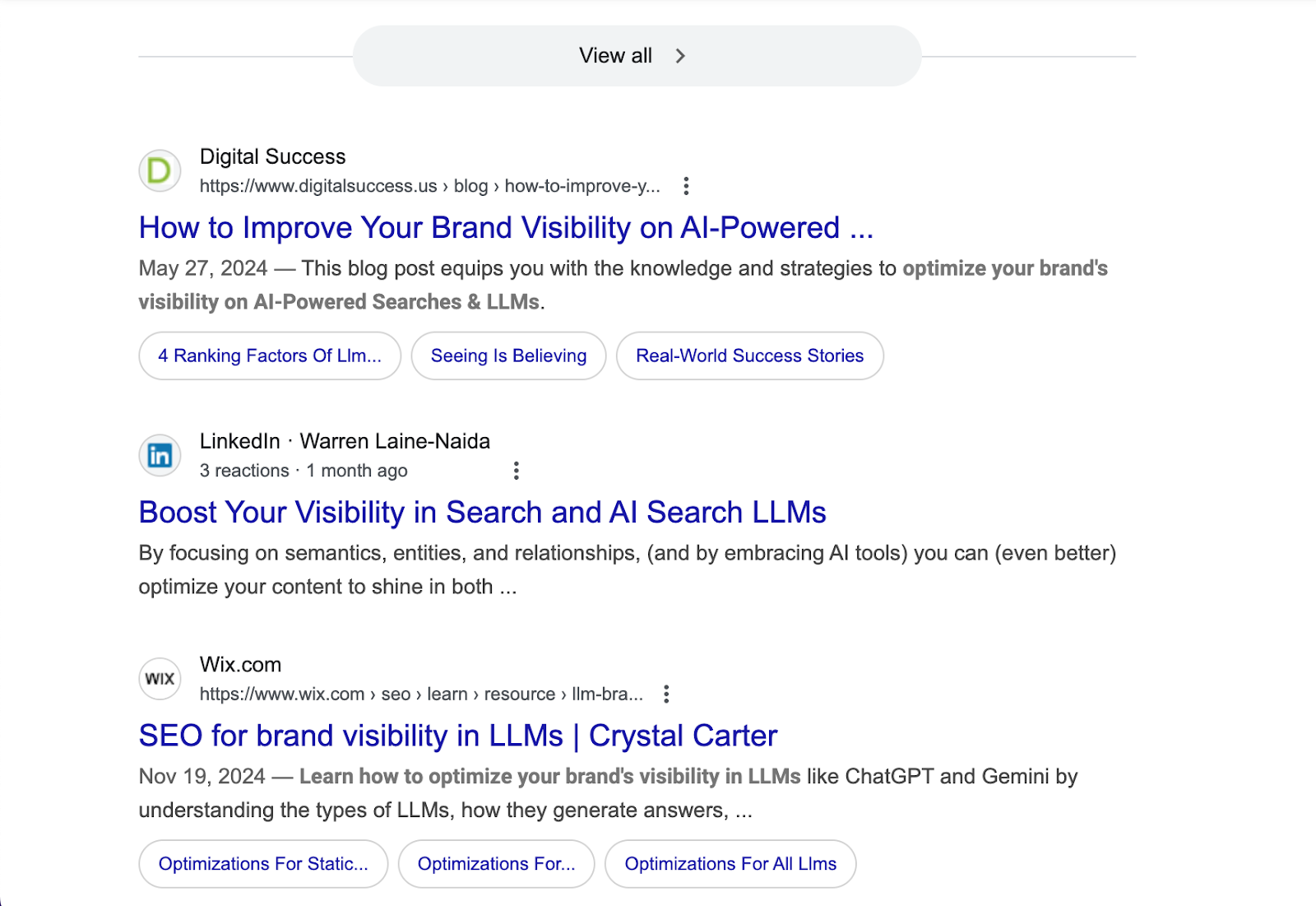
    Warren Laine-Naida has consistently A/B tested publishing on LinkedIn versus his website. Every single time, these articles are on Page 1 of Google SERPs and his website version is “nowhere to be found,” he told me. Indeed, for the following set of articles, the LinkedIn one shows up as the second entry under videos for the phrase “boost visiblity in search llms.”

    Oh yeah, articles on LinkedIn are indexed within 24 hours, too.

    LinkedIn: Boost Your Visibility in Search and AI Search LLMs

    Blog: Boost Your Visibility in Search and AI Search LLMs
    AD 4nXea9SlHkRV7BYTIJPzA7tBDxwZYFavX5cJ4jWoNLeUzStmoJm 6xwV4Fsdcq v4sMMsNJEv0pT7WHiAhrdVh6ufkBhYI9YgWNF v6FLLRoIiuyAoJVGo2NNx2Xe1A1 iSXSr bwTw?key=LX3OMp2bcEXdRL5t CpNR8zy

    You don’t always need people on your website. Especially when 44% of all Google searches are for brand names. When you are a SaaS founder or Freelancer, your brand is your name. You both want and need customers and investors to follow you.

    Get Marketing That Works

    I’ve been helping SaaS companies build a name for themselves in the B2B space since 2015. My company offers the perfect SaaS Marketing Package to help your internal team. And, if you’re ready to have your LinkedIn posts repurposed as articles on LinkedIn, we can certainly make time for you.

    I’m always open for a quick sales call.

  • SEO for Product Companies — You (Still) Need Blog Posts

    SEO for Product Companies — You (Still) Need Blog Posts

    SEO best practices are still best practices. If you have a product company (digital or physical) don’t just rely on your product pages. You need a blog. 

    It’s tempting to think blog posts are so 2013. Although with companies relying upon ChatGPT, Gemini, and other AI agents to write quick overviews and summary posts for (virtually) free, it’s surprising that product companies still don’t get it.

    TL;DR: People searching for knowledge are sent to blog posts. People searching for action are sent to product pages.

    Blogs Versus Short Video Dopamine Hits

    Physical products like fashion and beauty heavily rely on influencers and affiliate marketing. Tech companies rely on affiliate marketing, too. Why? Other people market for you which means a lower cost for marketing and lower Customer Aquisiton Cost (CAC). 

    Relying on other people to do the work can be a good thing. Until TikTok shuts down and you have no content on your own website.  

    Snapchat introduced the short vertical video and TikTok capitalized on them – thanks to the pandemic. Short, vertical videos are now the new podcast. My Gen Z niece listens to TikTok videos with her earbuds for hours. 

    “Are you watching them?” I asked. 

    “Sometimes. I mostly listen when I vacuum and clean the apartment. Of course, you have to stop to swipe to see the next video.” (I’m surprised TikTok hasn’t changed that yet.)

    Against biology (our eyes are made to scan right to left, left to right), every platform has this vertical, dopamine-inducing binge watch. Even LinkedIn has vertical video feeds now. (But that’s another rant.) 

    Relying upon third-party platforms for your marketing is a scary place to be.

    If Amazon’s bid to buy TikTok is accepted, it’s going to become the modern Home Shopping Network. How’s that going to change the user experience? Want to binge on commercials? Unlikely. TikTok will become as annoying as over GIF-ed, loud MySpace pages.

    Do Blogs Still Work for Sales?

    Yes. SEO best practices work as a whole to drive sales. Now, if your product pages aren’t optimized for PPC keywords, and you’re not running PPC ads, and you don’t have email marketing, and you don’t have blog posts to explain the why behind your products, then you have bigger problems. 

    This is a good time to say that unless you’re tracking your leads, you really don’t know how to attribute those leads. And, first-click leads? Those don’t exist.

    Google is still sending the lion’s share of traffic… but even when they — or most of the platforms, for that matter — do, we can’t even see that traffic because of the flaws in attribution.” Amanda Natividad 

    The Internet Runs on Words

    Here’s another thing I say a lot: the internet is blind. Videos may have captions (or craptions if you don’t edit them) and photos may be beautiful, but search works from words. 

    You still need customers. And how do you get customers to find the thing you just built if they don’t even know it exists? There’s no keyword research for terms people aren’t using. Keyword research is mostly for PPC anyway. 

    I say this a lot on Twitter/X, LinkedIn, Facebook, and in videos. No one will search for you if they don’t know you exist. If you built a product no one knows exists yet (like the product by my new client Green Link), no one is searching for a baseboard for a chain-link fence. It just got patented, and the website went live in January 2025.

    Do Blogs Still Work For Tech & SaaS Companies?

    Yes, blogs still work for tech and SaaS companies. Now, if you’re a product company, you may be ignoring your blog in favor of product development, writing their pages and documentation. (I know you’re behind on documentation.) 

    You’re super excited about this new tool or feature you built. That’s awesome. Do you hear us saying, “but why” when we read your tweet? What use case does this apply to? What problem does this solve? Why do I want a project management tool inside of WordPress? But Why?

    Well-written blog posts translate product pages into sales copy that answers the why. You can’t just post on X that you created a new tool with the link to the product page and expect sales (with or without lifetime deals).

    Blog Posts:

    ChatGPT Backs Up Long-Standing SEO Best Practices

    In a (not surprising) recent study analyzing which pages ChatGPT recommends (by AN Digital in German), blogs and editorial content were cited as top choices for informational queries. 

    The study by AN Digital found that if someone is looking for the best running shoes, they’ll be shown blog posts. If they’re looking for the best Nike running shoes, they’ll be shown a product page. What happens with Google also happens with ChatGPT.

    SEO best practices haven’t changed. Modern SEO – being found in an AI search tool like ChatGPT  – means you need to feed the machine. ChatGPT recommends real content by real experts. If you want to show up in AI-generated answers, an expertly-written blog post beats a static brochure site with product pages any day.

    “Because ChatGPT relies both on pre-trained data and real-time web access, SEO becomes critical in ensuring a company’s content is visible and usable by the AI.” AN Digital

    Get Marketing That Works

    I’m a marketing specialist in the SaaS space. That means easy onboarding for you. Let’s translate the features and specs of your product into compelling marketing copy for your blog. 

    There are limited spots for my SaaS Marketing Plan.

    I’m always open for a quick sales call to discuss your goals or get you on the waiting list.

    Sources

  • Do You Still Need to Blog in 2024, 2025, etc? Yes, Yes You Do.

    Do You Still Need to Blog in 2024, 2025, etc? Yes, Yes You Do.

    Instead of asking if you still need to blog in 2025, ask yourself if you still need customers in 2026 or if you still need sales.

    Here’s the short answer: yes.

    Yes, you still need a blog in 2026.

    Yes, even though people are using AI to write (the school calls it plagiarism), you still need to write and publish on your blog in 2025.

    Why?

    Let me count the ways.

    Oh and before this becomes way too hard to read, let’s agree that “blog” can be a verb meaning publish your writing. Blog is also the noun referring to the archive of articles you publish on your website.

    And I may just say “write” instead of blog. I would presume you’re also publishing these articles on your website (aka blog). Sound good? Let’s go.

    1. You write to establish yourself as an authority.
    2. You write so people can validate you as a business/service.
    3. You write to stay top of mind.
    4. You write to educate your customer base.
    5. You write to provide helpful tips for your existing customer base.
    6. You write because your competition isn’t writing.
    7. You write so you can be found on a search.
    8. You write to rank on Google.

    As another caveat, let me ask you a few more questions.

    1. Do you print materials like brochures to give out?
    2. Do you hand out business cards?
    3. Do you have radio commercials or TV spots?
    4. Do you have billboard or print ads?

    If the answer to any of these is “yes,” then your website better deliver. (We’ll come back to “validate your business” in that section.

    You write to establish yourself as an authority.

    Regardless of the nature of your business, you need to establish yourself as the authority. This means ensuring your author profile says your name and has a bio. Yes, the byline matters when Google/AI are deciding what to show.

    Are you a dry cleaner? Your website should help a consumer trust your business with their $500 suit. Are you a website designer? Your website should help a client choose you for their $2,500 website build. 

    You’ve read it so many times you can probably guess that I’m about to say that people do business with people they…? Know. Like. Trust.

    In a digital world where consumers are researching solutions to their problems way before you invented your plant trap (I so want one, thanks Instagram), you have to be trusted. Who do we trust? Subject matter experts.

    No seriously, look at the Instagram account for Plant Traps by RailScapes. It’s pretty great and they have a blog. Or Sam & Louie’s Pizza in Corpus Christi. It’s real. Authentic. Pam Chavez cared enough to go to school and learn the trade. Her story is why my BFF and I eat there. Now, is she blogging? No. But she is creating content which is a start. (Always back up your video content with blog posts on your own site. You don’t want your IG account to get hacked and then you lose everything. But that really is another blog post.)

    You write so people can validate you as a business/service.

    Remember earlier when I asked if you hand out printed materials and or business cards? So people know your website because they met you at a mixer, say. They don’t need window blinds right now but they keep your card. You’re a nice enough fellow so when they decide they want shutters — who do they look up first? You. 

    Your website has to back you up. In fact, your website is the best salesperson you’ll ever have. That is, if you maximize it. And you maximize it with your blog posts. Why? Websites don’t work 9-5. They don’t take vacations. Websites don’t call out sick (when you’re on a good host.) People can read and process the information on your website at their own pace. They can watch the videos. 

    You write to stay top of mind.

    As you think about all of the connections you’ve made over the years, how many people can you think of that you know are roofers? Go ahead. I’ll wait. How about a lawyer? I don’t mean Greg Hermann or Thomas J Henry. I mean a business lawyer. Oh yeah, there was that one guy who talked about LLCs back in 2021. But do you remember his name? Nope. Nada. Why? Because the interaction is gone.

    Now, people tend to not subscribe to blogs anymore (the best practice is email marketing campaigns with Mailchimp, for example). 

    People always ask me what they should post on social media. Blog posts. You should post links to your blog on your Facebook Page, on LinkedIn, and on X. You can even make a video out of your blog post with a service called Lumen5. I do it all of the time. 

    You write to educate your customer base.

    Educating your customer base is one of the most important reasons to have a blog. You want to clear up industry misconceptions, manage expectations, and have the customer closer to a yes by the time they call you. 

    Educating your customers means you’re using the same vocabulary which makes communication clear. How many times can you think of when you thought you bought something but was delivered something else? Too many.

    “I didn’t know I needed that!”

    In roofing, for example, you never know if the plywood sheets need to be replaced until — guess what? — the roof is removed. So that conversation is had during the bidding process. Any reputable company will give you the per sheet price in that bid, if it needs to change.

    This can also happen with a website build. “I just want a button.” Well, what does the button do? And are those services connected? And did you pay for the software? Getting on the same page is so much easier if you have articles and helpful FAQs on your website.

    You write to provide helpful tips for your existing customer base.

    If people are already customers, maybe they need help using your product. This is where Plant Traps does well on their blog. They’re doing presales work and giving ideas for current customers. If you’re providing an accounting service, publish articles so that your clients are ready for tax time. My CPA DiMercuiro Advisors does a great job with this (though I wouldn’t call it a “Learning Center”).

    Green Cremation does this very well with aquamation here in Texas. They write articles about obesity and the cremation process, the process of water cremation, as well as a complete guide to natural burial. Things you might not know about until you need to know. And none of us want to talk about death – again, another blog post. 

    You write because your competition isn’t writing.

    Everyone wants to compete with their competition. Wait. That sounded weird. Every business owner thinks other businesses are competitors. And, they very may well be. But the truth of it is that consumers make choices based on variations we can’t always account for. Maybe your business is chosen because customer A only wants to support women in business. 

    With that said, having an active blog on your website is a great way to stand out from the competition. To me, an active blog tells me that you’re in business. You’re not going anywhere. I won’t have to change service providers, find a new dentist, etc.

    (But you haven’t published in forever, Bridget. I know. I was in a car accident in December and had 8 herniated discs. That was a lot of pain and quite a bit of treatment. I’m finally feeling like myself. Thus, today’s blog post. And two more drafts in my head.)

    You write so you can be found on a search.

    Where was the last time you searched for a product or service? Was it Google? Bing? Siri? Alexa? Yelp? Reddit? Pinterest? Facebook? Maps?

    The truth is, our search intent has a lot to do with where we’re searching. For example, if we’re going out to eat and the restaurant is closed, we may open up Google Maps (my BFF is definitely opening up Yelp) to find a place nearby that is open now. If I’m watching a movie and just want to see where else I saw Chris Evans, I may just ask Siri.

    Of course, you want to be found. But you may also be found on a search in X, a hashtag on Instagram, a job title on LinkedIn, or even on Facebook. 

    Search doesn’t always equal Google.

    You write to rank on Google. (This is the worst reason to blog.)

    A lot of people believe that ranking on Google is the primary reason to blog. It’s not. Google’s search has been idiosyncratic for about a decade. Your search history frames the results that Google will show you. SEOs call this SERPs: Search Engine Results Page. Unless you’re in a private browser, your results will be different from Jack in Miami. 

    Everyone forgets about Local SEO. Meaning, most of us search for things around us: dry cleaners, roofers, dentists, restaurants, movie theaters, bars, etc. And most of the time, we’re making a purchasing decision with that intent. 

    Everything that you do in all of the reasons above has a cumulative effect on whether or not your website shows up on a search result for a user. 

    Are you going to start writing now?

    I hope the answer is a resounding yes. Send me your blog link. I’m happy to make suggestions. But the main thing is that you now understand that blogging isn’t a frivolous activity. Blogging is vital to the long-term success of your business. 

    More Resources

  • FREE 5-Step SEO Copywriting Workflow for Small Business Owners

    Hey, Bridget Willard here with BridgetWillard.com. Are you wondering how I write? What is my SEO framework? My, my SEO workflow is. I bet you would like that. Free, free, free thing about SEO framework. Not a framework, but a workflow.

    And, I may add here that is a must have for new business owners. Firstly, so you have enough education to prevent you from being bamboozled an secondly, so you are better equipped to have fruitful marketing conversations. Thirdly, to do it yourself. 

    So. Why is SEO important? 

    SEO is important because you want people to know that you’re in business. You want people to know that you’re an authority in your field. You want people to know that you have expertise and you want people to know that you are trustworthy. So no matter how you call it, whether it’s E A T or T E A — either way, those three letters are really important when you talk about S E O. Acronyms all day long. And I was just chatting with my friend, who said, I don’t even know what SEO means. And I told her, it just means being found on the internet.

    So what does that entail? First of all, you need to understand what your business focus is. What are you trying to get people to do once they get to your website? That is a super important aspect, because here’s the thing. Um, if you don’t understand that — here’s Diesel — if you don’t understand what it is that you want people to accomplish, then you won’t look for the right questions or the right, uh, keywords and everything like that. And you want the right keywords, right? Keyword Diesel Cat says “yes, keywords matter, but what matters more long tail keywords.”

    What’s the best long tail keyword. Bridget? 

    I will tell you, it is a question. Because people are using Siri, Google, Alexa, voice search, to get you to understand, oh, what is the net worth of Diesel The Cat? You know, when is the next NBA game? Why is it important for me to have a plumber who replaces the wax seal every time the toilet is unmounted from its seat? Right? These are all important questions. So I know you’re waiting, you’re waiting so patiently for the SEO Workflow.

    The SEO Workflow is simple.

    First of all, what questions do you get in your business all of the time? This is super important to think of. So are people asking you what your hours are? Are people asking you what you do? Have you defined a layman’s term versus industry term glossary? So for example, are you calling it a, an assisted living facility, a type B assisted living facility? But maybe the vernacular or the colloquial term is care home or residential care home. Right? Are you calling it a glulam beam? Yeah, that’s what it’s called, but people might call it a header or an exposed beam, right? They don’t necessarily know what the glulam, um, means. I mean, once you define it, it’s fine. So you want to use the same phrasing as your customer.

    And the why is this hard?

    This is hard because we — are are you ready? — we are not our customers. And, and as industry experts, whatever industry you’re in, we are most often in our own way. That’s the hard part. So you want to ask questions. Now I bet you’re wondering — four minutes in, you got to meet the cat — what is going on with your free SEO workflow for copywriting? Well, I’m gonna give it to you. Are you ready? So you just have to understand why you’re doing this first.

    So the first thing I do is I go into Google on my machine. I am not doing a screen share ’cause you guys could do that on your own and they’re super boring. But I open my machine and I type in a question. Now, if you type in a question, Google’s gonna auto complete it. So for example, um, you can ask, “when do I replace the wax seal on my toilet?” Now, Google may give you different variations of that because it’s suggesting the rest of your question. That is a question that contains a long-tail keyword. And since 99% of the internet is not on the first page of a search, you really want these long tail keywords.

    And don’t forget that search is idiosyncratic. 

    Meaning everybody who searches gets results based upon the browser they’re in, uh, the, the query they’re using. So there might be on Yahoo. People still search on Yahoo. I don’t know if is AOL still around? I just saw some AOL email addresses the other day. Um, people use Opera, they use Bing. They use GoDuckGo for search. They use something else. There was something else I saw. So there’s a lot of different browsers and most browsers have a, um, their own search. 

    But <laugh> when I say browser, it makes me think of The IT Crowd of Jen and the button for the internet. <laugh> Microsoft, <laugh> Microsoft Explorer. That was, those are the days, right? 

    About Voice Search 

    So the way that you get on the internet or the way you search for things, isn’t a browser if you’re asking Alexa, Siri, Google, et cetera, then that is its own browser. Like, “Hey Alexa, what’s the best place to buy a toilet?” Or “Hey Alexa, should I use an elongated toilet or a round toilet?”

    Like there are definite, uh, definite answers. That’s not going to help you in this case. You want to type it in yourself slowly so that Google will auto suggest. You ready? That’s the first step in your workflow? Well, the pre-step is make sure, you know, or you’ve made a list in a, in a, like if you have a notebook, write down a list of everything that people ask you and it like really annoys you, that somebody doesn’t know the answer to this question. Why do they keep asking to you over and over and over again? Why, why, why or how, how, how and what, what, what. What is this? What is that? What does that mean? Da, da, da, da. Make a list of those questions. Put a timer on your phone and list them out and then translate it into normal people jargon. If you’re not sure this is why this Google this first step in my SEO Copywriting Workflow is the most important. Okay.

    Step one review: type in Google, accept their answer — as long as it’s reasonable — that is the title of your blog post. That’s the title of your article. Okay. Place that into Word or I use Google docs. Then on that same page, once you get the results, you will see when you scroll down a section called People Also Ask, and there will be four or three to four questions there that you can actually expand. If you click on a little thing right here and it’ll go <sound effect> and you, so first you’ll see the zero answer or the featured snippet. Then you might see some ads and then you’ll see People Also Ask. Again, you need to do this on your actual machine. It doesn’t always appear this way on mobile.

    So after you’ve done that, look at those People Also Ask.

     If they’re all super similar, then it might not work. But most of the time, I just copy those and paste them into my Google document. Um, and then of those, I pick three of ’em to be my H2s. H2 is like the way that HTML the. When you’re writing for the internet and when you see something on the internet, it’s, it’s written in hyper text markup language, H T M L hyper text markup language. And so we want it to be an outline because using these headings in a consecutive order allows Google et al, any search engine, to appropriately index and outline your thoughts. Okay? So why this is important is that, um, well, first of all, it’s good for accessibility, but it also gives the reader an opportunity to see those choices.

    And again, Google is giving you the cheat sheet. This is the cheat seat, cheat cheat seat, ah, cheat sheet for S E O. Cheat seat. Ah, I can’t say it. <laugh> Shelly sells seashells by the seashore. <laugh> it’s a tongue twister. The cheat sheet for SEO. Right? So people also ask.

    One auto complete the question. Two people also ask. Now, now you have your outline. The fourth H2 will be your call to action. Are you curious more about this topic? Now? What you gonna wanna do is in at least one of those H2s and it probably should be that way. You want to make sure that your keyword is in there. You want your keyword, not everywhere. Like just putting Justin Bieber, Justin Bieber the way we used to or not we, but black hat SEOs. So you want your keyword in the meta description. You want your keyword in the title. You want your keyword in, uh, the first paragraph. You want your keyword in the last paragraph and it in at least one of those H2s. Okay. So step one, auto complete. I’m not taking, I’m not giving you a worksheet. So take notes or rewind <laugh> you gotta watch the video.

    Um, step one is auto complete. Step two People Also Ask. Step three, add your own H2 for the closing paragraph, with the call to action. The call to action should be signed up today, learn more, get it now. And it links to your product, your contact page, something like that. What do you want people to do now that they’ve read this article? Answer that question there. So now you’re almost finished writing the article and that’s all you’ve done. 

    Step three is go back to those first page results. 

    If you’re not there and find something of one of those first page quotes of links to quote in your article, — as long as it’s not a competitor. Right? So this is why when I’m writing for Launch With Words, the content packs for Launch With Words are written this way. So they are written to be specifically generic. So the plumbing pack, for example, will refer to This Old House or Kohler a manufacturer, right? But it’s not going to link to Bob’s Plumbing in San Antonio, because it’s not, you do not want to link to your competitor. Right?

    So this is the framework. So find something that, that is appropriate for that within those first few articles that you can quote within your article. Now at this step, you have a title. You have People Also Ask. You have a call to action. That’s three, you have quotes. That’s four. Now, five fill in the rest. It’s faster than, uh, <laugh> faster than writing a five paragraph essay.

    Five free tips to SEO workflow for copywriting.

    This workflow for blog content and articles are so important. I am very behind on writing for my own website, but I will tell you another trick. You can edit content and that is still a change your site map. And that’s what Google wants.

    So if you have questions, if you have concerns, if you have issues, feel free to comment, uh, on YouTube where this video will live or in the blog post, or I’ll see you on Twitter. Bye.

    Thanks for bearing with my transcript of the video. Feel free to share. 

  • Is Your eCommerce Shop Ready for Cyber Monday?

    Getting your online shop ready for Cyber Monday shouldn’t be as overwhelming as it feels. This is especially true if you start in the summer. My days of being in church leadership taught me one valuable lesson: the holidays descend upon you like an avalanche. Don’t wait to plan these events. 

    What is Black Friday?

    Black Friday is the day that American Consumers live for all year. Even recently, my friend asked me, “Why would you buy a blender today? Wait until November.” Well, because I need a blender today. That’s why. Sure, we can fill up our wishlists and then hit the mall at midnight on Thanksgiving Day and fight over the last Cabbage Patch Doll. Hey, I’m not a Black Friday shopper. I’m too cynical. 

    I know that retail prices are inflated so that the sale can seem large. Besides, I prefer to sleep. And as far as Christmas presents go, if I buy any gifts, it won’t be on Black Friday. The crowds are too much for me. To each their own.

    What is Cyber Monday?

    After Web 2.0 gave us the ability to purchase online — thanks to eBay and Amazon — Cyber Monday began to rise as an alternative to the crowds and fistfights that became Black Friday. Seriously, if you didn’t grow up in the 80’s you don’t know the half of it. And that’s part of what drives the Cyber Monday sales — to keep people out of the crowds. The pandemic helped with that as well. 

    “Since it was inception in 2005, Cyber Monday has grown exponentially. What began as a small sale with a handful of retailers turned into over $2 Billion in sales in 2014. This year is projected to be even bigger.” Duct Tape Marketing 

    Cyber Monday is specifically for online stores, software, and tech. So, why do my WordPress friends have Black Friday sales for their WordPress Plugins? I’m not sure, to tell you the truth. I wish they would use Cyber Monday for the sale — if they really need that promotion. 

    I’m Not a Fan of WordPress Plugins Going on Sale 

    I realize that my views are slightly controversial. But stay with me here. See, if you push your WordPress plugin for sale on Black Friday or Cyber Monday then you will be pushing most of your customers with annual renewals at the same time. 

    If the majority of your customers renew their licenses at the end of November, then the majority of your customers buy at a discount. Can your plugin shop thrive by selling your product at a discounted price? If it cannot, then you must markup or inflate the plugin license cost so that your company can survive on the discount. And this feeds into itself. Since the majority of your customers renew in November, what will your December renewals be? January? February? You can see how that can easily become problematic. 

    I’d rather have a healthy cash flow all year-’round than wait until after Thanksgiving to become profitable. Secondly, you’re training your customers to wait for the sale — as my friend suggested with the blender. Leave Cyber Monday for the gadgets and video games. 

    If you want more of my fantastic marketing advice, you can purchase my book, “How to Market Your Plugin” from Amazon. This book will not be going on sale. 

    Will Launch With Words Premium Content Packs Be Going on Sale?

    No. I will not be hosting a sale on Cyber Monday for Launch With Words, my ebook, or my content planner. Why? Firstly, they’re already priced low to be accessible. To me, retail is all about pricing strategies that have to do with ridiculously high markups. My products are already value-priced. 

    Stop Competing For Black Friday

    Does it really matter which day you do it? Well, sure it matters which day you have the sale. Firstly, if your eCommerce shop is small, to compete with Amazon on Black Friday or Macy’s or Sam’s Club is just insane. Not to mention the fact that after Black Friday is Shop Small Saturday. I’m a firm believer in staying in your own lane for one and not competing with brands that have larger advertising budgets than you do. 

    “Over the years, Black Friday and Cyber Monday have vied for dominance. In 2020, Cyber Monday was the top day consumers planned to shop, with 30% saying they planned to shop Cyber Monday sales, compared to 24% saying the planned to shop on Black Friday. (Source: BlackFriday.com Shopping and Spending Survey 2020).” BlackFriday.com

    How About a WooCommerce Tip?

    I joined Bob Dunn on Do The Woo, among other industry experts including Katie Keith and James Rowland — to name a couple — with some of my best tips.

    Listen to the whole podcast.

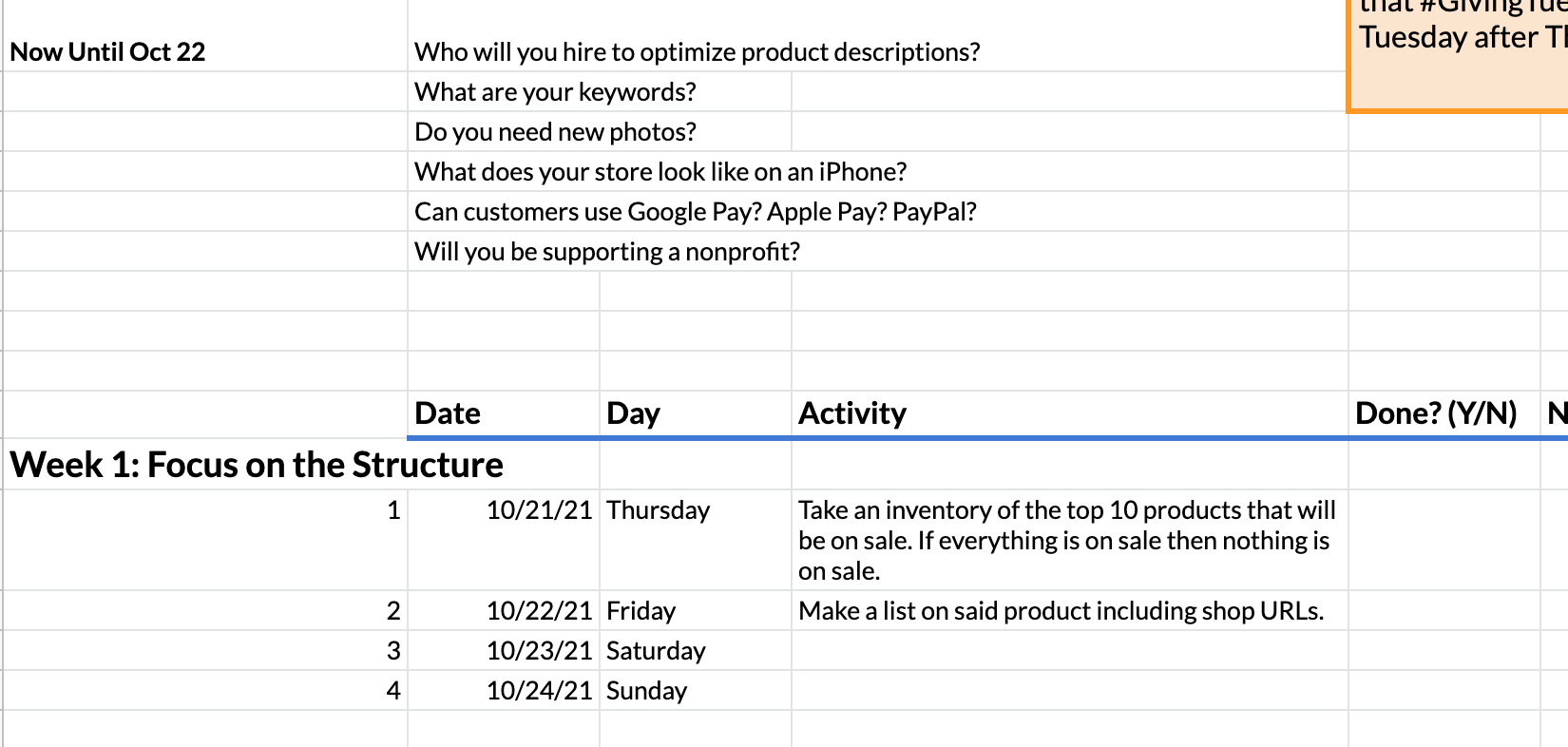
    Hi, this is Bridget Willard with bridgetwillard.com. My tips for Black Friday is to leave Black Friday to the brick-and-mortar store. Cyber Monday is our day to celebrate and I would also give you this tip, take an inventory of the top 10 products that will be on sale. If everything is on sale, then nothing is on sale. Make a list of those products and ensure that you have updated photos, reviews, and website copy on all of those products. If you don’t have 10 products, then pick one that’s really going to go on sale. Which one is your loss leader? Think about that. And also a bonus tip is make sure you have one image for your product page that is 1200 by 628 pixels. This is because of open graph, social sharing. You don’t want to look like Amazon with this big old wide field and your book right in the middle. So those are my tips for Black Friday.

    Get Ready for Cyber Monday With a Free To-Do List

    I have a for every working day from October 21 until CyberMonday. Get organized. Get your eCommerce store ready and let Black Friday be what it is — the day for brick-and-mortar stores to become profitable. 

    It’s free, so , and copy the Google Sheet to your own Google Drive. Then get to work on October 21. 

    E89sO8EBZbQ0n3NrOrT IMwjgqJtRcK34al EpZNmIrrXAdH1H448tA5dn0w5UrVde1IM eBapYE d8vv0TqnFlem0JDGS9lC1manI BaLjJLTneFodDPjDyw03FbpeYXvZTdzvf=s0