
I remember the first time I saw “GTM.” It reminded me of the Pontiac GTO. What the heck is GTM. If you’re new to this marketing term like I was, it means “Go To Market” and it usually means your marketing strategy for your SaaS Product. To explain, let me tell you a story.
In 2003, everybody wanted Nemo. Finding Nemo came out, saltwater aquariums were suddenly even cooler, and I happened to be working at Evans Roofing Company where we had an empty aquarium sitting in our conference room.
One of our employees was a microbiologist. She asked if she could turn it into a saltwater aquarium.Of course Mark Evans said yes. How fun, we were going to have fish!
Except we didn’t. Every week we’d come into that conference room for our staff meeting and I’d look at the aquarium.
“Where are the fish?”
First, the tank had to be cleaned and tested. Then came the sand and rocks. The water had to be prepared. The tank had to cycle. Eventually there were shrimp and snails and other creatures in there.
Okay. Great.
But where are the fish?
It turns out you can’t set up a saltwater aquarium by buying an aquarium and throwing Nemo into it. You have to build an entire ecosystem capable of supporting Nemo first.
Yesterday, I was thinking about SaaS founders tweeting, “My product is live! Go to my GitHub.” Sometimes they post in a subreddit. Sometimes they share their Product Hunt launch through DMs asking me to vote on their product.
I felt like I’ve run out of ways to explain that there is so much infrastructure you need to build first. Then I remembered the salt water tank and it hit me. The long, (boring) process of setting up a salt water reef tank is the perfect analogy for go-to-market strategy.
Watch the Video
The Fish Are the Leads. The Tank Is Your GTM Strategy.
SaaS founders, like me and my coworkers in 2003 are impatient; we just want to see the fish. Why is this taking so long? You built the product. You launched the website. Maybe you created an X account. You put your product on Product Hunt.
And now, crickets. You can’t seem to find your first 10 customers let alone your first 100.
Where are the leads? Where are the downloads? Where are the demos booked?
But SaaS product marketing isn’t a collection of individual acts; those are just tactics. Creating an X account isn’t a marketing strategy. Publishing a website isn’t a marketing strategy. Writing four blog posts isn’t a marketing strategy. Launching on Product Hunt isn’t a marketing strategy.
Your go-to-market strategy is creating a living ecosystem made up of interconnected parts. They have to be established in the right sequence, monitored, and continually adjusted.
That’s what makes the saltwater aquarium analogy so useful.
You don’t get the fish first. You build the conditions the fish can live in.
Let’s work the analogy and get you back on track. Follow the science.
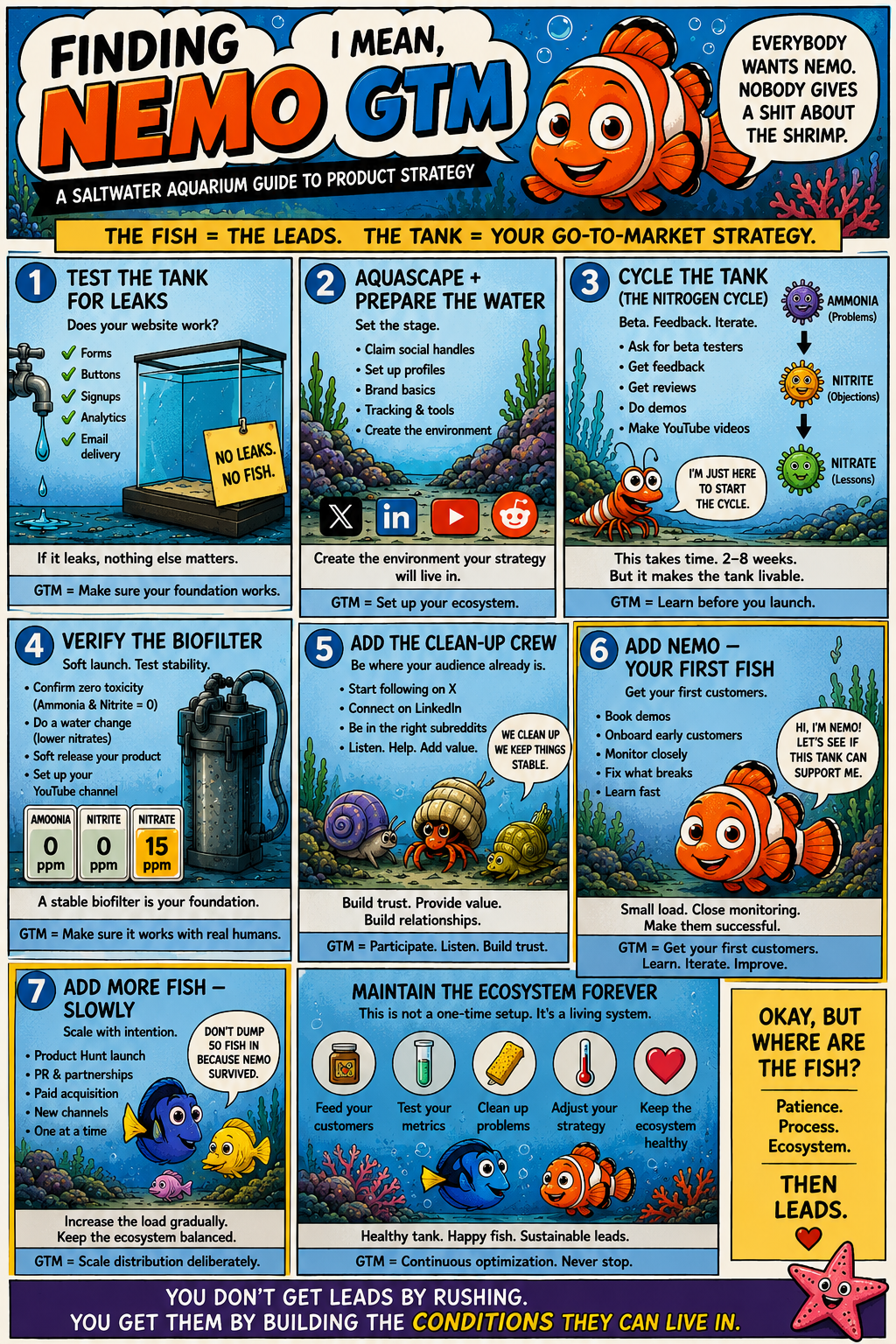
1. Test the Tank for Leaks: Does Your Website Actually Work?
Before you worry about marketing your SaaS product, test the tank. Does your website work? Not on your developer’s machine. Not locally. Not while you’re logged into WordPress.
In the real world. In 5G. On crappy shared WiFi in a coffee shop.
Open it on an old laptop. Open it on an iPhone. Turn off WiFi. Try the forms yourself. Do they work as expected? Can a salesperson, a business owner, a non-techie navigate your website?
Test your:
- Forms
- Buttons
- Signups
- Checkout
- Analytics
- Email delivery
- Onboarding
What happens after I book a demo? Do I get confirmation? If I fill out a form, do I know you received it? If I pay you money, does the process work the way I expect?
You know what you programmed the website to do. That’s exactly why you should have someone who doesn’t know, test it.
If the tank leaks, nothing else matters.
2. Aquascape and Prepare the Water: Establish Your Environment
Now you can start creating the environment your strategy will live in. Claim your social handles and make sure the links in your website footer work. Set up your profiles with the same information.
Establish your brand basics. Make sure Google Analytics and any other tracking are working. Create your YouTube channel and optimize it with playlists, links to your website, etc. Aim to upload 3-5 videos.
You don’t have to actively publish everywhere yet*. But you should establish your presence before somebody else claims the handle — and before you suddenly need the channel.
This is aquascaping.
By the way, incase you’re Dory and you forgot what we’re talking about, we still don’t have Nemo in the tank.
Trust the process, friend. Trust. The. Process.
*When you’re ready to actively publish, this is where I come in. So review the pricing and build in budget for that now. If not me, then another SaaS Marketer like Gregory Kennedy of Vibe Your SaaS.
3. Cycle the Tank: Beta Test Your Product
This is the part everyone wants to rush. Please, don’t.
A new saltwater aquarium needs 2-8 weeks to establish the biological filtration that will make the environment safe for fish. That’s the nitrogen cycle.
Your SaaS product needs a cycle to breathe and make sure the waste cycle works, too.
Beta testers are your nitrogen cycle.
- Invite people to use the product (ideally on a landing page).
- Watch them use it if possible.
- Ask for detailed feedback.
- Do demos in person or over Zoom. *Bonus points for recording some of those for your YouTube channel.
- Ask them what it would take for them to change to your product over their current solution.
- Get reviews from your beta testers for your website.
- Find out what confuses them.
- Find out what they thought your product did before you explained it to them.
- Iterate your product, revise the copy on your website, update the documentation/knowledge base.
This is where your product positioning starts meeting reality.
It’s also why you can launch with reviews. Those reviews don’t magically appear on launch day. Your beta testers have already been using the product.
The goal here isn’t attention. It’s learning from your customer base. It’s possible you’ve gotten beta testers outside of your ideal client, too! All learning is learning. This is why you soft launch with hearty fish, not super expensive dream fish.
4. Verify the Biofilter: Soft Launch With Real Humans
Now make sure that your new SaaS ecosystem can support actual people.
- Soft launch your product.
- Test your positioning.
- Test your website.
- Test onboarding.
Watch what happens when someone who wasn’t involved in building the product tries to use it.
This is also when I’d start building your demo and YouTube infrastructure. People want to see how software works from step one. There are a lot of visual learners, so show them. When you’re working on your YouTube videos, it’s important to edit your captions (SRT file). The Deaf and Hard of Hearing community calls them “craptions” for a reason. This is also pure gold to feed into Claude/ChatGPT for blog posts that support the videos.
Create demos; this doesn’t have to cost a lot of money with a tool like NeetoRecord. Record interviews. Show behind-the-scenes processes. Use something like Guidde to record step-by-step instructions. Eventually, turn successful customers into case studies.
Your product doesn’t become trustworthy because you say it works.
People need evidence that it works.
Bonus points for doing case studies here. “But Why?” is a question I’m also asking. Why should I switch to your product? Why should I give you my credit card for this product? What does it do?
If you’ve gotten this far and you’re nodding your head, but not ready to get my full package on my home page, then book an hour consult. Let’s get you going in the right direction, friend.
5. Add the Cleanup Crew: Go Where Your Customers Already Are
This was the most frustrating part of the aquarium for those of us waiting for pretty fish. Shrimp? Are you kidding me? No one gives a shit about shrimp, let alone snails, or hermit crabs. We all thought Jill was building a tropical reef aquarium. Why are we looking at snails?
Here’s the thing. It’s all about infrastructure. You see, a salt water aquarium is a closed ecosystem. Meaning, it has to support itself in all of the cycles of life: birth, death, poop, etc.
The shrimp are vital because they create and maintain the waste ecosystem that makes the fish possible.
Your marketing cleanup crew is participation (your participation).
- Start following people in your category on X.
- Connect with customers and peers on LinkedIn.
- Find the appropriate subreddits.
- Pay attention to communities where your customers are already talking.
- But here’s the important part:
- Listen before you broadcast.
- What alternatives are people asking for?
- What frustrates them about the tool they’re already using?
- How do they describe their problem?
- What words do they use that never appeared in your original positioning document?
This isn’t just social media management. It’s customer intelligence. Every story you read online is teaching something about your audience.
And this is also why I recommend SaaS founders publish articles on LinkedIn. Your expertise needs to exist where your customers and peers are already encountering you.
6. Add Nemo: Get Your First Customers
It felt like forever. We’re a quarter in by this time and your salt water tank is finally ready to add fish. Well, one fish. Specifically, a hearty fish. We’re still not at the dream fish stage. Sorry, not sorry.
Your ecosystem has demonstrated that it can support life. Now you can start converting.
- Book demos.
- Get your first customers.
- Onboard them carefully.
- And then watch everything.
- What breaks?
- Where do they hesitate?
- What generates support tickets?
- What questions do they ask?
- What did they expect to happen that didn’t happen?
Your early customers aren’t merely revenue. They’re giving you the information you need to make the entire ecosystem stronger. This is about scale. This is about sustainability. Grow or Die? You don’t want to die before you grow.
This is when product, support, sales, and marketing should be best friends.
Learn. Iterate. Adapt. Improve.
Then reflect what you learn in your documentation, website, product pages, onboarding, demos, and positioning.
7. Add More Fish Slowly: Now You Can Scale Distribution
Nemo survived. Excellent. You’ve kept your first customer(s) and have little to no churn. Right on! Break out the champagne. But you still have to be cautious.
That does not mean you dump 50 fish into the aquarium tomorrow. You can deliberately increase the load. The key here is being intentional about scaling. You don’t want 4000 downloads tonight and 300 support tickets. That’s no bueno
This is where you’re ready for:
- Product Hunt Launch
- Broader distribution
- PR
- Partnerships
- Paid acquisition (PPC, Meta Ads, etc.)
- Additional marketing channels
Product Hunt itself describes access to its community of early adopters, tech enthusiasts, makers, and product people as one of the primary reasons to launch there. It also has an entire preparation process for makers before launch day.
That’s precisely why I don’t think: “I have a GitHub repo. Let’s launch on Product Hunt!” is a GTM strategy.
You have more questions to ask.
- What happens if the launch works?
- Can your website handle the spikes in traffic?
- Can your onboarding handle the new users?
- Can your support handle the extra questions? (Do you have at least a support vendor?)
- Does your positioning make sense to someone seeing you for the first time?
- Can your tank handle more fish?
Wait. We Haven’t Started Blogging Yet.
If you’re reading this fish related GTM strategy and thinning, “where are the blog posts,” and confused. It’s intentional.
I don’t want you publishing 30 generic “SEO” articles because somebody told you that SaaS companies need a blog. (That somebody may have been me, to be fair, but timing matters.)
At the beginning, you don’t know enough yet. Don’t even get me started on how early you are for keyword research either.
Your beta testers and first customers are going to tell you what you should write about.
I want to know:
- Why did you build that feature?
- What problem does it solve?
- Why should I endure the pain of switching from the software I already use?
- What went wrong?
- What surprised your customers?
- What are your use cases?
- What questions keep coming up during demos?
Those are blog posts.
- Your sales objections are blog posts.
- Your support tickets are blog posts.
- Your comparisons are blog posts.
I’ve written before about how to turn SaaS objections into blog posts because those objections are really customer questions. Once you’ve been listening to beta testers, prospects, support, and your first customers, you have something much more useful than a generic keyword list.
You have customer language which is SEO/LLM gold.
Now your content strategy can emerge from the ecosystem instead of being bolted onto it.
And once you’re publishing those ideas on your own website, you can distribute and develop them elsewhere. That’s where LinkedIn articles, X, YouTube, communities, newsletters, and other channels start reinforcing one another.
That’s the system.
Maintain the Ecosystem Forever
Here’s the other problem with treating GTM like a launch checklist:
You think you’re finished.
A saltwater aquarium isn’t finished when you put the fish in it.
- You still have to feed the fish.
- Test the water.
- Clean things.
- Monitor the temperature.
- Deal with problems.
- Adjust the ecosystem.
- Marketing works the same way.
- Your customers change.
- Your competitors change.
- Search changes.
- AI discovery changes.
- Social networks change.
- Your product changes.
- The language your customers use changes.
- Your strategy has to respond.
My own approach to SaaS marketing is built around this feedback loop: monitor conversations in the category, participate, turn customer questions into content, and bring those signals back into the marketing strategy. See how I approach SaaS marketing
That’s not a campaign.
It’s ecosystem maintenance.
Okay, But Where Are the Fish?
I understand the impatience. It’s very exciting to build something new and see it work. It’s your creation, like a child, or a pet – or a fish.
I was the person sitting in the conference room asking when we were finally going to get the damn fish.
As a founder, you may be asking the same question.
Where are the leads?
The answer isn’t necessarily another campaign. It isn’t necessarily more blog posts. And it isn’t necessarily launching harder or dumping money into PPC.
Sometimes the answer is that the ecosystem isn’t ready to support what you’re asking it to produce.
- Test the tank.
- Prepare the environment.
- Learn from beta testers.
- Soft launch.
- Participate in your community.
- Get your first customers.
- Listen to them.
- Then scale.
You don’t get leads by rushing.
You get them by building the conditions they can live in.
Get Marketing That Works
I’m Bridget Willard. I’ve been marketing SaaS products successfully since 2015. I’ve got time to work on your product marketing, do you?
Book a quick sales call or a paid consult today!