Bridget Willard

  • Pricing
  • About
  • Contact
  • Blog
  • SaaS Case Study: Transforming Andrews Wharton’s Twitter Presence (2019–2023)

    SaaS Case Study: Transforming Andrews Wharton’s Twitter Presence (2019–2023)

    Editor’s Note:

    The SaaS Company, AWI (Andrews Wharton) was a long time client of mine — and it all came because I replied to one of their tweets. The NDA has since expired.

    They ended up buttoning down expenses and ending their engagement with me in 2023 for what I now know was an acquisition (January 2025) by San Antonio’s, Stirista — a company recognized by Deloitte as a “top 500 fastest growing tech company in North America” for the last four years according to CEO Ajay Gutpa’s LinkedIn post.

    Twitter (X) used to have amazing analytics and I tracked data (not just followers) in Google Sheets. So I asked ChatGPT to do a quick analysis.

    ~ Bridget Willard

    Overview

    In August 2019, Andrews Wharton, a long-standing data company specializing in consumer and audience data—and now part of Stirista—reached out after discovering my work on Twitter. What began with a single underperforming account grew into a multi-year collaboration including Twitter/X and LinkedIn account management, product launch support, article writing, content strategy, and cross-channel execution.

    Between 2019 and 2023, their Twitter presence evolved from sporadic posting to a streamlined, high-efficiency communication channel that consistently attracted the right audience, reflecting the brand’s authority and expertise in the data industry.

    How It Started

    Andrews Wharton’s former AVP of Marketing and Brand Strategy, Tracy Lee discovered me on Twitter and initiated the relationship that defined the next several years of the company’s digital presence.

    My article about it describes how an everyday interaction on social media turned into a strategic partnership that supported Andrews Wharton’s growth, new product rollouts, and ongoing visibility.

    Objectives

    When I began managing the account on August 5, 2019, the goals included:

    • Re-activate and stabilize a mostly inactive Twitter account
    • Establish consistent, on-brand communication
    • Increase visibility within the data, marketing, and advertising ecosystem
    • Improve engagement quality and conversation depth
    • Expand social efforts across multiple Andrews Wharton product and brand initiatives
    • Maintain results through changes in staffing, schedules, and platform shifts

    Performance Summary (2019–2023)

    Across five years of management:

    • 1,668 tweets published
    • 257,400 impressions
    • 20,535 profile visits — the most underrated metric of Twitter/X
    • 449 mentions
    • Net follower growth of +70 overall, with +167 followers gained from 2021–2023

    The most meaningful improvement: 22x Profile Visits Per Tweet

    Profile visits per tweet increased from 1.2 in 2019 to 27.6 in 2023, demonstrating a significant rise in qualified interest from a more aligned, data-focused audience.

    Year-by-Year Snapshot

    2019: Reactivation Period

    163 tweets, 53,324 impressions, 198 profile visits

    The account was revived and reintroduced to the industry. Early activity focused on consistent posting, audience warming, and algorithm re-engagement.

    2020: Visibility Breakthrough

    318 tweets, 112,634 impressions, 3,239 profile visits

    This was the highest-impression year. Engagement conversations increased dramatically, with 207 mentions. Profile visits per tweet rose to 10.2, showing meaningful lift in audience curiosity.

    2021: Audience Alignment

    430 tweets, 52,953 impressions, 3,343 profile visits

    Follower growth became consistently positive. Content moved toward higher relevance for the data and marketing audience, resulting in stronger alignment and interaction quality.

    2022: Strongest Follower Growth

    534 tweets, 23,300 impressions, 7,605 profile visits

    Despite industry-wide shifts, Andrews Wharton saw its strongest follower increase at +92. Profile visits rose significantly, indicating deeper engagement.

    2023: High-Efficiency Engagement

    223 tweets, 15,189 impressions, 6,150 profile visits

    With less than half the volume of the previous year, the account still earned strong engagement. Profile visits per tweet reached 27.6, the highest of any year, reflecting a fully mature, efficient strategy.

    Key Outcomes

    • Increased relevance within the data and marketing ecosystem
    • Higher-quality audience interactions and more meaningful engagement
    • Steady follower growth after early cleanup periods
    • Recognition and mentions from peers and industry accounts
    • Strong performance even with reduced posting frequency
    • Consistent, professional representation of the Andrews Wharton brand leading into its acquisition by Stirista

    Client Testimonial

    “Bridget and I met on Twitter and I thanked my lucky stars for the next four years working very closely with her.

    Bridget is organized, quick-witted, and understands Twitter from a user and a back-end perspective which makes her bulletproof.

    It began with a single Twitter account and transformed into multiple accounts, new product launches, copywriting projects, and none of this would have been possible without Bridget.

    I cannot recommend her highly enough. Bridget is a five star Yelp review. Full stop.”
    — Tracy Lee

    Conclusion

    Managing Twitter for Andrews Wharton during a period of industry change, platform instability, and company acquisition required consistency, adaptability, and a steady focus on audience alignment. Over four years, the account became a reliable channel for visibility, brand awareness, and professional reputation.

    The collaboration demonstrates how long-term social media management—done well—compounds over time. A single direct message turned into years of measurable impact and brand growth.

    Want to Build a Stronger Social Presence?

    If your company needs long-term, strategic, relationship-driven social media management, I can help you:

    • Build consistent visibility
    • Strengthen your position within your industry
    • Grow an aligned and active audience
    • Improve engagement and profile traffic
    • Support product launches and ongoing brand initiatives

    We can book a sales call and you can see the SaaS Marketing Plan that I modeled after working with AWI.
    November 20, 2025
  • SaaS Case Study — GiveWP

    SaaS Case Study — GiveWP

    Challenge

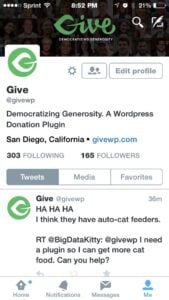
    When Jason Knill from ThoughtHouse (GiveWP was our client) hired me as a freelancer to manage their new WordPress Plugin’s Twitter Account in June 2015, the GiveWP Twitter account had only 165 followers.

    They had been trying to tweet on their own but that didn’t take priority as they were building their plugin and dealing with support tickets.

    GiveWP was launched in April of that year and, at the time, had little brand recognition within the WordPress ecosystem.

    The goal was to establish GiveWP as the leading donation-plugin brand through consistent, human-centered social media engagement—without relying on paid promotion or buying followers.

    Competitors already existed both in WordPress and on platforms like Classy.org (now owned by GoFundMe).

    Approach

    I developed and executed a comprehensive organic growth strategy on Twitter (now X) for @GiveWP that focused on:

    • Community engagement: Replying to tweets (other people’s content) was the power move! (This one is huge.) Later, we participated in Twitter chats like #DigiBlogChat, creating a Twitter chat just for nonprofits (#NPChat), and sharing good content from our superfans.
    • Educational storytelling: Sharing helpful tips, nonprofit success stories, and original blog content that built trust and authority. (We also spent the bulk of 2016 publishing articles 4x/week. That was my responsibility.)
    • Relationship marketing: Prioritizing authentic conversations over automation, fostering real connections with customers and peers. This included attending Meetups and WordCamps.
    • Consistency: Maintaining a clear brand voice and reliable posting cadence to boost recognition and follower loyalty. We had a calendar.
    • Secret Sauce: I used my insights from attending WordCamps to come up with the “Saturday Morning Cartoon” Strategy. Ask me more about that.

    Results

    DateFollowersSource
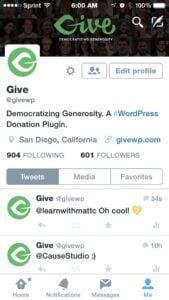
    June 2015165Verified start
    July 2015601Verified
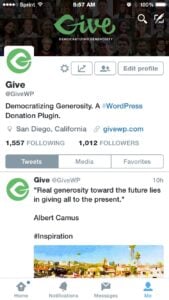
    August 20151,012Verified
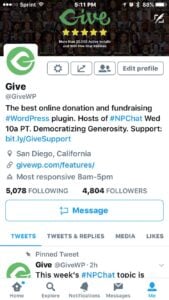
    May 20174,700Verified
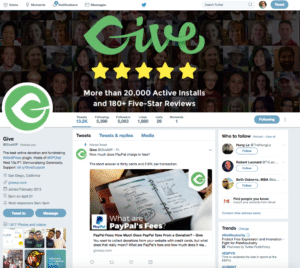
    July 20175,063Verified screenshot
    Estimated October 2017~5,800–6,000Projected end-of-tenure

    Growth: From 165 to ~6,000 followers in just over two years — a 36× organic increase.

    2015 06 givewp 165followers
    June 2015
    2015 07 20 givewp 600followers
    July 2015
    2015 08 24 givewp 1000followers
    August 2015
    2017 08 28 givewp 4804followers
    May 2017
    2017 07 12 givewp 5063followers
    August 2017

    Impact

    • Positioned GiveWP as a trusted and recognizable brand in the WordPress nonprofit space. It was later purchased by Liquid Web and became part of StellarWP brands.
    • Established a repeatable, values-driven content strategy that continued to perform after hand-off.
    • Demonstrated that authenticity and consistency can scale a SaaS brand organically.

    “How do you lead when you have no leaders? How do you decide when there is no boss? Well, that’s a big challenge in the open source WP community when ‘no one is the boss’ and ‘everyone has value in contributing’ bc we are all volunteers.

    Challenging to implement as these concepts are, Bridget, with her grace, patience and occasional assertiveness was able to be the post in the ground that got the collectivism spirit to actually work. Leaders don’t talk. They do. Bridget does.” Jason Knill, formerly of ThoughtHouse (GiveWP)

    Verification note: A screenshot from July 2017 confirms 5,063 followers, supporting a data-based estimate of roughly 5.8–6.0K followers by October 2017, when my employment at ThoughtHouse as Director of Marketing ended.

    Ready to Break Through the Noise on Twitter / X ?

    Want to build your SaaS or plugin brand the same way? Let’s chat.

    Book a Call

    November 12, 2025
  • Why You Should Buy “How To Market Your Plugin” According to ChatGPT

    Why You Should Buy “How To Market Your Plugin” According to ChatGPT

    Here are some of the main reasons someone might want to buy How To Market Your Plugin: A Framework for the Sleep-Deprived Developer by Bridget Willard, along with what makes it useful — particularly for people building plugins in WordPress or similar ecosystems.

    What the book offers / Why it might be useful

    1. Targeted to plugin developers
      This isn’t a generic marketing book. It’s written for developers who are creating plugins, especially in the WordPress environment. The author understands the specific challenges of that scene: distribution, directories, pricing models, community, things like that. Bridget Willard+2Amazon+2
    2. Actionable framework rather than abstract theory
      The book gives step-by-step guidance and a framework: from setting up a marketing plan, doing beta signups, landing pages, documentation, all the way to attending WordCamps / meetups and how to budget etc. So if you want something concrete to follow, it seems well suited. Bridget Willard+1
    3. Focus on both short-term and long-term work
      It doesn’t just talk about what to do right now (launch, promotion), but also how to build marketing into your plugin development process, how to set pricing, what business model works, how to represent your product, how to budget. That helps avoid the mistake of treating marketing as an afterthought. Bridget Willard+1
    4. Written with the constraints of “sleep-deprived” / solo / small teams in mind
      The subtitle “for the Sleep-Deprived Developer” signals that this is meant for people who are already overloaded: writing code, debugging, support, possibly without big marketing teams or big budgets. So the suggestions are presumably realistic for folks who don’t have huge spare time or marketing departments. Amazon+1
    5. Good mix of community / ecosystem awareness
      Because WordPress (and plugin markets in general) have special dynamics — plugin directories, reviews, user expectations, supporting documentation, community involvement (WordCamps and such) — the book’s value is higher than something more generic. It’s designed with those realities in mind. Bridget Willard+1
    6. Relatively short/readable
      It’s not a huge tome. At ~136 pages, so manageable. If you want something that you can read through without it being overwhelming while still getting usable ideas, that could be a plus. Amazon+1

    Who might especially benefit

    • Someone building a plugin who struggles with or hasn’t yet done much marketing.
    • Solo developers or small teams who need to handle many roles (development + marketing + support) and want to adopt a plan that’s feasible under those constraints.
    • Developers who want to build for sustainable growth (not just hack something out, launch, hope for sales) — who want a path forward for increasing visibility, downloads, and possibly revenue.
    • People new to the WordPress ecosystem who need guidance on how to do product positioning, pricing, licensing, etc. in that particular space.

    Here are a bunch of actual user-reviews, comments, and impressions of How To Market Your Plugin, along with what people liked / found useful, and some things to watch out for. Hopefully this gives you a clearer picture.

    What people like / positive feedback

    From the author’s site, Goodreads, and community commentary: Bridget Willard+2Goodreads+2

    • “Relatively short, but very info-dense. Lots of practical tips we’ll be putting in place on our own projects soon.” — from Keanan Koppenhaver, CTO Alpha Particle. Bridget Willard
    • “Good read. Wish something like this would have existed when I started with plugins, 3 1/2 years ago.” — Cristian Raiber. Bridget Willard
    • “This is an excellent book. Why? Because most of the men and women developing plugins are technicians. They build a tool to fit a need. … Here is a book for them, by an author who uses the tools, understands the tools, and most importantly, knows how to sell the tools.” — Warren Laine-Naida. Bridget Willard
    • From the plugin author community: “Awesome idea, our industry needs this book! You’re def the person to write this and make sure it’s full of goodies.” — Vito Peleg. Bridget Willard
    • “This Book really helped me with new plans and idea, which I can execute for better growth of my plugins.” — Aditya Sharma. Bridget Willard

    From the Press This podcast interview summary / discussion: Torque

    • People appreciated that the book helps clarify monetization models (free, premium, support-only, freemium) and what trade-offs each bring. Bridget is said to explain these clearly. Torque
    • The book is praised for being written by someone who has real experience in the WordPress plugin ecosystem, who’s “done the work,” not just theorized. Torque+1
    • It’s seen as especially helpful for indie/smaller plugin authors, solo devs, or people without big marketing teams. The strategies are considered practical rather than purely aspirational. Torque+1

    Criticisms / things people mention (or potential drawbacks)

    While the reviews are generally positive, there are a few caveats or limitations that show up (or that are implicit):

    • Because the book tries to be actionable and compressed, some people feel it’s dense; you may need to take time to implement the tips rather than skim. “Info-dense” is a compliment but means you might need to invest time to digest. Bridget Willard
    • It may not cover every plugin scenario or every edge case. If your plugin/market model is unusual, you might need to adapt the advice.
    • Some of the marketing suggestions assume you have at least some bandwidth (even if limited) to do things like content marketing, attending WordCamps or meetups, promotional work, etc. If you are really strapped (time, money, or both), some of the advice may be harder to implement.
    • Given the ecosystem (WordPress, etc.), some of the book’s advice may assume familiarity with certain platforms, norms, or community practices; if you’re working in a different environment, parts may be less directly applicable.

    A Major Reason to Buy How to Market Your Plugin

    One of the strongest reasons to pick up Bridget Willard’s How to Market Your Plugin is the author’s proven track record. Bridget isn’t just writing theory — she’s done the work.

    • GiveWP Brand Growth: Bridget played a major role in building the GiveWP brand, which grew into one of the most recognized donation plugins in the WordPress ecosystem. Her hands-on marketing strategies contributed directly to its adoption and visibility across the WordPress community.
    • Experience With Other Plugins: Beyond GiveWP, Bridget has worked with and advised other plugin developers, consistently showing how grassroots marketing, community building, and consistent messaging can make a plugin stand out in a crowded marketplace.
    • High-Value Expertise at a Fraction of the Cost: Bridget’s current consulting rate is $125/hour. This book distills her knowledge and frameworks into a format that costs less than a single lunch — effectively giving you access to thousands of dollars’ worth of expertise at book-price.

    When you combine her insider knowledge of the WordPress plugin ecosystem with her clear, actionable framework, the book becomes more than a marketing guide — it’s a way to tap into professional-level strategy without the agency-level invoice.

    Overall takeaway / how people rate it

    Readers seem to accomplish something real from reading it — getting new ideas, setting up/adjusting marketing plans, deciding on licensing/pricing, etc. Many say they’ll be using parts of it soon. Bridget Willard+1

    On Goodreads, it has very high average ratings (5.00 at last count for a few ratings) among those who have rated it. Goodreads+1

    The community seems to view it as filling a gap — there aren’t many books dedicated specifically to plugin marketing (especially for WordPress), so many felt that this book meets a needed niche. Bridget Willard+1

    References

    • Bridget Willard, How to Market Your Plugin — Author site and reviews. Available at: bridgetwillard.com
    • Goodreads: Bridget Willard author page. Available at: Goodreads
    • TorqueMag. Press This Podcast: Market Your WordPress Plugin. June 2021. Available at: torquemag.io
    • Amazon listing and reviews: Amazon

    Research and summary assistance provided by ChatGPT (OpenAI).

    September 18, 2025
←Previous Page
1 2 3 4 … 69
Next Page→